
Europe Is One of the Safer Places in the World for Women — But the Statistics Require Context
Sarah Pardi - October 2, 2026
Home > Travel Guide > Travel Safety & Health > Europe Is One of the Safer Places in the World for Women — But the Statistics Require Context
Share this post
I've done my fair share of traveling solo over the past 15 years or so. I've even moved overseas by myself - twice.
Traveling alone is an incredibly rewarding experience. We've all heard of stories like Eat Pray Love, Letters to Juliet, and Wild. There's a reason the topic gets written about and played on screen over and over again.
There's also a reason I keep traveling alone over and over again, even though I am married and could just as easily travel with my partner.
Traveling alone as a woman is completely doable. In fact, governments have entire sections of their websites dedicated to the topic. All travel comes with risks (it's one reason travel insurance is so important), but as women, we can face extra risks and obstacles.
It's all about the research
The US, UK, and Canadian governments encourage all travelers to research their destination(s) before traveling to them. It's even recommended specifically to women.
During your research, maybe in between trying to score the cheapest flights you can, look up the culture of your destination. Different cultures have different norms, and some of these can be related to gender.
The British Government recommends looking specifically to see if other women have received "unwanted attention or difficulties because of their gender."
Sometimes, this kind of information can be found on government travel pages, usually listed under travel advisories or safety sections. This is the case for the advisories and safety information that the US government publishes.
However, you can also get information from social media groups and online forums (Facebook, Reddit, etc.). That said, always remember, forums are not an official source, so take the information you find there with a grain of salt.
The Canadian Government recommends that female travelers get country-specific information from women who were born and raised in your destination, and/or those who travel to that specific country or place regularly.
The European Union and other organizations, like the United Nations, have entire departments and projects dedicated to women's and girls' safety. According to the UN, European countries are continuing to make significant improvements in policy, safety, and opportunity, specifically for women. Still, it doesn't mean you shouldn't do your own research ahead of time.
The OECD (Organisation for Economic Co-Operation and Development) regularly conducts gender-related studies. One that I find quite interesting is their survey on how safe a woman feels walking alone in a specific country at night. The information is publicly accessible. In the table alone, you'll see the country in question.
On the right, you'll find the percentage of women who reported feeling safe walking alone at night. The table is sorted by countries where women felt the safest.
| European Country | % of Women Who Feel Safe |
|---|---|
| Luxembourg | 87.9% |
| Norway | 87.4% |
| Switzerland | 86.8% |
| Slovenia | 86.2% |
| Estonia | 82.2% |
| Austria | 80.7% |
| Finland | 80.6% |
| Denmark | 78.9% |
| Iceland | 78.6% |
| Ireland | 78.2% |
| Portugal | 78% |
| Spain | 78% |
| United Kingdom | 75% |
| The Netherlands | 74.5% |
| Germany | 74.4% |
| Sweden | 73% |
| Latvia | 71.6% |
| France | 71.5% |
| Lithuania | 71.3% |
| Poland | 70.7% |
| The Czech Republic | 67.9% |
| Hungary | 65.9% |
| Belgium | 63.9% |
| Slovakia | 62.3% |
| Italy | 60.3% |
| Greece | 53.7% |
When you look at information like this, it's important that you remember that the numbers don't reflect how statistically safe a country is. This is a general feeling/consensus from surveyed women living in the area.
Still, it's a valid conversation, and a question that comes up over and over in Facebook groups and Reddit threads: How safe is it to walk alone at night?
While government-reported data is reliable and trustworthy, statistics are often averages or snapshots of specific time periods.
The European Union, for instance, has a goldmine of data and information through its statistics branch, Eurostat. Eurostat conducts surveys, looks at and organizes international (EU) data, and more to give citizens and travelers information on important topics. Women's safety, health, and equality are a few (of the many) things that they report on.
Every year, Eurostat updates this dataset to reflect the most recent numbers on physical violence against women. In the report, the information tells you the percentage of women in a specific country who have reported violence from a non-partner (physical violence, sexual, or otherwise).
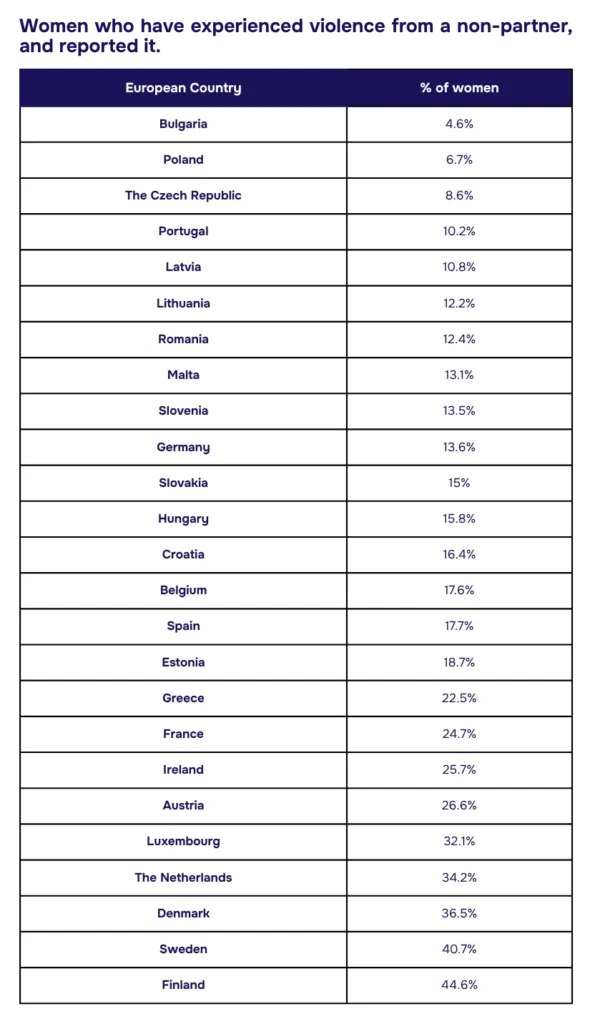
Women who have reported violence from a non-partner and reported it
| European Country | % of Women |
|---|---|
| Bulgaria | 4.6% |
| Poland | 6.7% |
| The Czech Republic | 8.6% |
| Portugal | 10.2% |
| Latvia | 10.8% |
| Lithuania | 12.2% |
| Romania | 12.4% |
| Malta | 13.1% |
| Slovenia | 13.5% |
| Germany | 13.6% |
| Slovakia | 15% |
| Hungary | 15.8% |
| Croatia | 16.4% |
| Belgium | 17.6% |
| Spain | 17.7% |
| Estonia | 18.7% |
| Greece | 22.5% |
| France | 24.7% |
| Ireland | 25.7% |
| Austria | 26.6% |
| Luxembourg | 32.1% |
| The Netherlands | 34.2% |
| Denmark | 36.5% |
| Sweden | 40.7% |
| Finland | 44.6% |
You can see that Bulgaria, Poland, and the Czech Republic report the lowest percentages, while Denmark, Sweden, and Finland are at the other end of the chart.
It's interesting because, if you look at the first table I shared, women in Finland and Denmark have relatively high feelings of safety at night. Sweden sits somewhere in the middle.
Cultural differences play a part in reporting.
A few years back, several analysts published a peer-reviewed study discussing why Nordic countries' rates of violence against women are statistically higher than those of other European countries.
The study found that women are more likely to report violence in environments where violence is openly discussed and where public awareness of gender-related violence is higher. The study itself is worth taking a look at because it really proves that there is always more than meets the eye - especially when it comes to statistics.
If you're heading to Europe...
Make sure you're insured. Low prices, quality coverage.
Taking local transportation alone
In general, Europe's public transportation is quite safe. There is a reason why the Paris metro is so famous, after all. Still, even in the statistically safest countries, it's important to be aware of your surroundings.
Many European countries and organizations are proactively working to write and pass new legislation that further protects women, even in public transportation settings.
In March 2026, for example, the British Transport Police (BTP) launched a new initiative to improve women's safety on public transportation in the UK.
Police, rail operators and staff, the government, and community groups are working together to reduce violence against women and girls that happens on public transportation.
According to Girlguiding, the UK's largest charity dedicated to girls, 56% of British girls do not feel safe using the UK's public transportation alone.
Apart from physical safety concerns, financially motivated "attacks" happen too. Taxi scams are prevalent, though in those cases, it's more about overcharging you than it is about putting you in physical danger.
When you're traveling, especially when you're alone, you should always:
- Make sure you've hired a reputable taxi or car service. Taxi scams can (and do!) happen at airports and train stations, even in relatively safe cities like Paris.
- The US Government recommends that female travelers use popular ride apps (some popular ones are Uber, Bolt, Lyft, etc.). Just make sure the app serves the country you're going to.
- Do not hitchhike!
- Avoid extremely crowded buses and trains when you can. This can get tricky in busy cities, but crowded transport can create a scenario where it's easier for someone to be inappropriate. It also makes it easier for pickpockets to steal phones, wallets, passports, and even entire bags. When I was an au pair in Madrid, my friend's backpack was stolen right in front of us. We never even saw it happen.
- Avoid taking public transportation alone at night.
- If available in your area, consider using "women-only" or "female-owned and operated" transportation services.
None of this information is meant to discourage you from taking public transportation in general. In fact, I take public transportation when I travel alone, and I have in several different cities throughout Europe. Paris, Barcelona, Bruges, and London, to name a few.
It's a great option for solo female travelers, but it is important to be cautious and aware of your surroundings. And it's reassuring to know that both governments and organizations are taking the fear and the issue more seriously.
The best tips for women traveling solo
Understanding the local norms and knowing how to get around safely are two of the most important things you can do before traveling alone.
But still, there are other things you should consider doing before you head abroad, or even while you're already on your trip.
Know the healthcare system before you go
Healthcare systems vary around the world. While Europe (and especially the EU) generally has good healthcare services, there are some countries, regions, or locations that may not have adequate facilities or doctors nearby. This is particularly true if you're planning to go somewhere very remote or rural.
This is one of the reasons that travelers take out travel insurance, actually. Most travel insurance policies will include repatriation or medical evacuation. Essentially, if there's a real medical emergency, they can help you get back home or to the best nearby facility for your needs.
Register under your initials
When you book your hotel, a ride-share, or anything else, consider using your first initial and last name instead of your first and last name. This way, it's more difficult for others to tell what your gender is. Avoid using "Mrs", "Ms", or "Miss" on official forms if possible.
This is also a good idea if you're getting any deliveries, like Uber Eats or Deliveroo.
Tell your loved ones where you are
Make sure someone back home knows your itinerary, even if it's a rough itinerary. It can be worth it to get an eSIM so you are able to be contacted, whether you're on Wifi or not.
Plan what to do in an emergency
Look up the emergency phone number for your country.
Throughout the EU, you can dial 112 in case of an emergency. That said, some countries have other emergency numbers too. I have found that just putting the emergency numbers into my phone in the notes section, or sending them to myself via email and "starring" them to easily find later, gives me more peace of mind.
Knowing the emergency number is great, but if you want to take it one step further, you can also look up where the closest police stations and hospitals are where you're going. This way, if an emergency occurs, you know exactly where to go.
It's still worth saying: if you're ever having a medical emergency, or believe you are, dial the local emergency phone number.
Unfortunately, date-rape drugs exist
As truly horrible as it is to think about, date-rape drugs do exist. While they're 100% illegal in Europe, it doesn't mean they're non-existent.
Attackers can use drugs like scopolamine, ketamine, and rohypnol to render their victims unconscious. This is typically done by putting a tasteless, colorless powder into your drink (such as at a bar).
The US, UK, and Canadian Governments all have very clear advice about this. First, never accept drinks from strangers. When you do have a drink, alcoholic or not, keep it where you can see it at all times. If you're able to cover it (even with your hand), that's better.
If at any point you start to feel sick or strange, tell someone you trust if you're able to, and then immediately call emergency authorities.
You can also always contact the embassy of your home country. For example, if you are American, you can contact the US Embassy at your destination for help.
The UK government warns that alcohol is the most common drink used when attackers are attempting to drug you. That said, it works in non-alcoholic drinks, too, so it's worth being aware of, especially if you're in a busy bar or nightclub.
Be cautious on your social media
It's really fun to share all of the amazing travels you do. I know I am excited to share photos almost as soon as I take them. Still, it's better to wait.
You should avoid posting about what you're up to in real-time, and instead wait until you've left specific places before sharing that you've been there.
The Canadian Government explicitly says that sharing your location in real-time can put you at risk.
I like to take a lot of photos, and then once I am back in my hotel room, I edit them for fun and then post them all that evening. Just make sure your location sharing is off on your social media accounts. Or, I'll sometimes save up all my photos and mass edit them on the plane ride home. There usually isn't wifi on planes, and I can't be bothered to purchase it, so it also gives me something fun to do to pass the time.
All in all, Europe is generally considered safe to travel to. But just like anywhere else, there are exceptions. A bit of research and remaining cautious (especially at night, on public transportation, or in crowded areas) is a must for women traveling solo, whether it's to a European country or anywhere else on our beautiful planet.
Like this post? Bookmark Insurte's Travel Guide for more like it.
 Sources & references
- Internal Expertise & Review
- Sarah Pardi is a frequent traveler and European travel expert at Insurte, a global travel insurance company specializing in Schengen visa insurance. With three international moves under her belt and frequent travel throughout Europe, Sarah has a passion for sharing travel advice, tips, and information. She has contributed expert opinions and commentary in several reputable sources like Business Insider, Travel & Leisure, Kiplinger, the BBC, and more.
- Government Advice for Female Travelers:
- US Advice for Women : Official advice for solo-female travelers from the US Government.
- CAN Advice for Women : Official advice for female travelers from the Canadian Government
- UK Advice for Women : Official advice for women traveling abroad from the United Kingdom
- Girls' Trip Advice : Advice and information for "girls' trips" from the Canadian Goverment
- Research & Data:
- Annual Equality Report (UN) : Report of the Under-Secretary-General/Executive Director of the United Nations Entity for Gender Equality and the Empowerment of Women on the implementation of the Strategic Plan 2022–2025
- Gender Gaps : The OECD dashboard on gender gaps relating to health and wellbeing
- Violence Against Women (EU) : Women who have experienced violence by a non-partner, by type of violence, 2026 from Eurostat
- Rates of Violence Against Women : A press release detailing statistics on rates of violence against women, 2024
- Nordic Paradox (study) : Peer-reviewed study discussing rates of reporting and cultural influence
- Gender Based Violence : Statistics from the European Union on gender-based violence
- Organizations & Programs:
- VIAWG Strategy (UK) : The UK's strategy to combat transportation related violence against women
- Girlguiding Charity : The UK's largest charity for girls
- Written by:
- Sarah Pardi - Staff Travel Advisor
- Fact-check and reviewed by:
- Clément Goubon
- Last updated:
- October 2, 2026
Learn more about our editorial standards and review process in our Editorial Policy.
Tags
Related posts

Upcoming travels ? Get Insured !
Find the right insurance for your trip by using our powerful comparison tool!