

The first question that Schengen visa applicants have is almost always the same. How much is it going to cost?
In transparency, there are two costs that most applicants need to think about. There is the official visa fee, which is a fixed amount and the same no matter where in the world you apply. Then, there is everything else around that, like insurance (it’s mandatory), service charges, specific documents, and other things that make your total overall application costs increase.
This guide covers both, with exact 2026 figures, people who may be exempt from paying, and a few legitimate approaches that can help you spend less throughout the process.
Don't Forget This Visa Requirement...
Compliant insurance is mandatory for Schengen visas
How much does a Schengen visa cost in 2026?
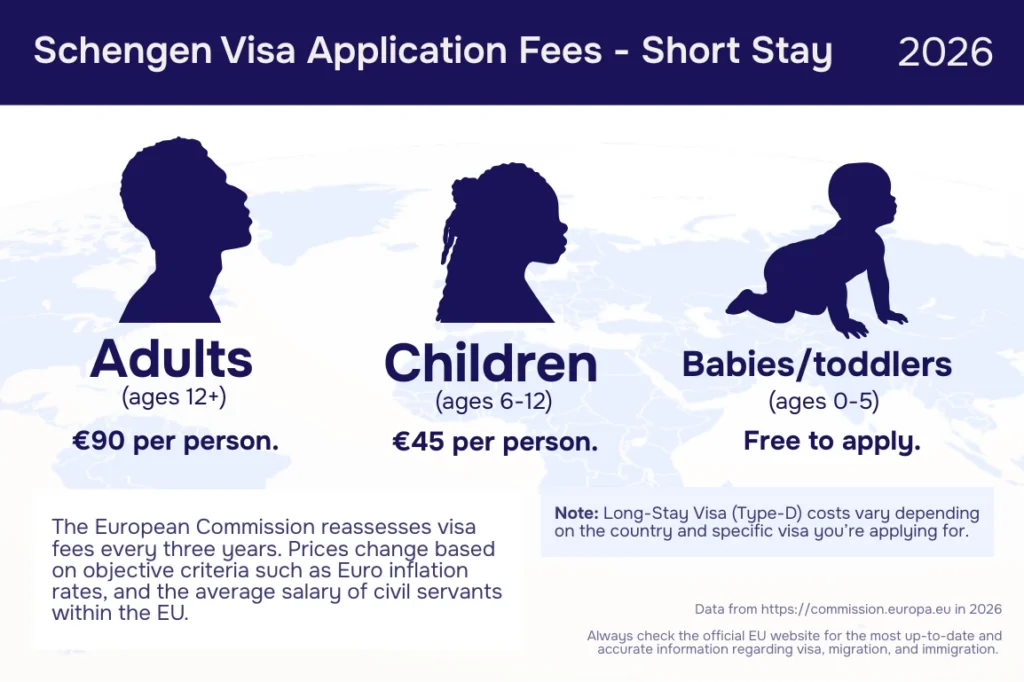
The Schengen visa fee is €90 for adults in 2026. Children ages 6 to 11 cost €45, and children under 6 can apply for free. This is the Short-Stay fee (Type C), and it’s the same across all 29 Schengen states. The fee is the same whether you’re applying for a single or multiple-entry visa.
The Schengen visa fee hasn’t changed since June 2024, when the European Commission raised it from 80 euros to 90. Here is how the current fees compare to the former ones.
| Age of traveler | 2026 fee | 2024 fee | Change |
|---|---|---|---|
| Adult (12 and older) | €90 | €80 | +€10 |
| Child ages 6-11 | €45 | €40 | +€5 |
| Children under 6 | Free | Free | No change |
Why did the Schengen visa fee go up?
While it may seem random, price increases aren’t arbitrary. Under the official Visa Code, the European Commission reviews the cost every three years and then can adjust it under two objective measures. The first is the euro area inflation rate, and the second is the average salary of public servants throughout the Schengen Area.
Looking at the two, the Commission changes the fee. In 2024, the cost jumped up about 12% in total. The last increase before that was back in 2020, when the fee had a pretty big jump from €60 per adult to €80.
Worth knowing. While most people adults to pay that 90 euro rate, there are travelers from specific countries that have a lower rate. This is because of visa facilitation agreements between their countries and the Schengen area.
Is the Schengen visa fee the same in every country?
Yes. For Short-Stay Type C visa applications, the fee is the same whether you’re applying for one for Germany, Spain, Italy, or any other country in the zone. Unless you are a citizen of one of the countries with a visa facilitation agreement, you’ll pay the standard fee.
What can change (and often does) are the service fees. Most applicants apply for a Schengen visa through a visa application center. Visa application centers typically charge service fees in addition to the application cost itself (the 90 euro number). Also, this number is for short-stay visas (maximum 90 days). Long-stay visa fees vary from type to type and country to country.
Does a multiple-entry visa cost more than a single-entry one?
No. This is a common misconception. The fee is 90 euros whether you are applying for a single, double, or multi-entry visa.
Get Schengen Compliant Insurance Today
Schengen visa insurance is mandatory for applications. Download your certificate now.
What extra costs should you budget for?
The visa fee isn’t the only cost you’re going to have if you’re applying for a Schengen visa.
Once all of the mandatory costs (such as service fees) and case-by-case costs are accounted for, the total amount could be 150 to 200 euros. More if you need to travel for your visa appointment. There are things to think about like travel insurance (which is mandatory), document translation if necessary (which can run 15-20 euros per page), potential travel… the costs
Mandatory extras, insurance and service charges
There are three costs that are really hard to avoid.
The first of those is the visa application center. Most countries partner with official visa processors to facilitate the application process. Examples of these are TLScontact, VFS Global, and BLS International. If a country partners with a processor, usually it’s mandatory to apply through them. When this is the case, you have to pay service fees on top of the visa cost.
The second non-negotiable is Schengen travel insurance. Some may think it’s a nice-to-have, but it is compulsory. The Visa Code explicitly says that all Schengen visa applicants have to be covered. On top of that, you can’t just pick and choose the cheapest option you find. The Visa Code states that the policy must include a minimum of €30,000 euros in emergency medical coverage and include hospitalization and repatriation. It also needs to cover you in every single Schengen country, regardless of your actual itinerary. Lastly, you must be covered for the entire stay.
Document preparation
Depending on your file, you may need to get certified translations, notarized copies, or apostilles. Translations of bank statements, for example, can be costly depending on the service you have available to you.
Who is exempt from the Schengen visa fee?
Some travelers don’t have to pay anything for a Schengen visa, as noted above. Some only have to pay partial fees, based on agreements with the zone.
Who pays zero. Children under the age of 6, some academics and researchers traveling for work, close family members of EU citizens (when traveling with them), some non-profit and cultural representatives, some diplomats, and those who fall under some humanitarian categories.
| Full waiver (0 euros) | Condition |
|---|---|
| Children under 6 | Applies everywhere |
| Close family member of EU citizen | Directive 2004/38/EC |
| Some researchers | Travel for scientific research |
| Some pupils and students | Study or educational training trip |
| Some non-profit & cultural representatives | Seminars, sports, cultural events. It depends |
| Some diplomats | Diplomatic passport holders |
Two reduced tiers sit alongside the waiver. Children aged 6 to 11 pay €45 everywhere. Separately, nationals of certain countries that signed visa facilitation agreements with the EU pay €35. Here too, the passport decides, not the place of residence.
There are also those who can pay a reduced amount. Children aged 6-11 cost €45 per person. Nationals of specific countries within the EU only have to pay €35. These countries include Albania, Armenia, Azerbaijan, Bosnia and Herzegovina, Cape Verde, Georgia, Moldova, Montenegro, North Macedonia, Serbia, and Ukraine.
Do not confuse a fee waiver with a visa waiver
Being exempt from the visa fee (or falling into a category that allows you to pay a lower rate) does not mean you are exempt from needing a visa. For context, a one-year-old still needs a visa application filed in their name, even though the visa fee is waived. And, even if the visa fee is waived, there may still be applicable service fees.
Are Schengen visa fees refundable if you are refused?
No, Schengen visa fees are not refundable, even if your visa is rejected. The fee pays for your application’s processing, so it is kept whether your visa is approved or denied.
How do you pay the Schengen visa fee?
It can depend. In some cases, you may need to pay the visa application fee before you head to your appointment. In other cases, you will pay the fee at the visa center or consulate when you submit your application.
It can depend on where you’re applying. If you need to pay online, you’ll be prompted to do so. Just follow the instructions/steps provided by you to the consulate/visa application center.
What a Schengen visa really costs for a family of four
If you only look at Schengen visa fees, you’re going to see a number that doesn’t really accurately reflect what you end up spending. With service fees, things like travel insurance and appointment travel, the total cost is usually higher.
Take a family of four living in the US, traveling to France. Let’s say there are two adults and two children ages 9 and 4. They will need to fly to another state to attend their visa appointments. Here is what the final costs could look like once everything is said and done. Keep in mind this is purely an example. Service and travel costs vary.
| Family member | Visa fee | Service center fee* | Travel insurance* | Flight (visa appointment) | Hotel (visa appointment) | Total |
|---|---|---|---|---|---|---|
| Adult 1 | €90 | $25 | €40 | $400 | ||
| Adult 2 | €90 | $25 | €40 | $400 | ||
| Child, age 9 | €45 | $25 | €40 | $400 | ||
| Child, age 4 | Free | $25 | €40 | $400 | ||
| Totals | ~$257 | $100 | €160 | $1600 | $200 total | $2,317 |
If the real cost of a visa were visa fees alone, the total cost would be €225 (approximately $257). However, there are always other costs associated with the process, especially if you (and your partner/family) need to travel out of town for your visa appointments. Depending on your family size, where your appointment is, how much coverage you want, and more, costs can be in the hundreds or thousands (in the US).
This isn't to discourage you; it's to be transparent about what the costs can actually look like.
If only you need a Schengen visa, and you live in the city where your visa application center is located, costs can be significantly less. It depends on so many factors.
How to lower your Schengen visa costs
Visa fees are non-negotiable, meaning you can’t try to persuade officials to give you a better price. However, there are ways to trim your costs here and there. First, if a consulate allows for direct applications, apply there to bypass visa center fees. This isn’t always an option, but if it is, it can shave a bit off the total amount you end up paying.
Second, if you are a frequent traveler, you should consider annual travel insurance. Two trips or more a year can sometimes make an annual plan cheaper in the long run. Just double-check trip maximums to ensure you’re covered for when you plan to be traveling. Providers like Insurte let you weigh both options so you can do a price comparison side by side.
Another way to save a little money is to take your own Schengen visa photos. We have a guide here that tells you all of the requirements.
If you need to travel out of town for your appointment(s), try to book your trips in advance to get the best deals on flights and hotels.
A note on choosing where to apply
When countries partner with visa processors, you usually don’t get to choose between applying directly at the consulate or at a center. Additionally, in some countries, you may need to apply at a specific center or consulate. For instance, in the US, there are French visa application centers throughout the country. However, you have to apply at the one you’re sanctioned for. This means if you live in Oregon, you need to apply in Seattle. Texas? Houston. So on and so forth.
Schengen visa cost, frequently asked questions
 Sources & references
- Internal Expertise & Review
- We're passionate about helping travelers plan and travel more confidently. For more than 15 years, our team of internal experts has been providing accurate, in-depth information about European travel requirements. We're dedicated to sharing relevant, up-to-date details around Schengen travel. This page is monitored regularly and updated as policies and prices evolve and change.
- Schengen Visa Costs:
- Current Schengen Visa Costs : The European Union's Visa Policy Page
- Schengen Visa Application Fees : Application fees, the Belgian Government
- Schengen Visa Fee Increases
- 13 June 2024 Press Release : Press release outlining the 2024 price increases
- 13 June 2024 Announcement : Fee increase announcement from Business France
- Written by:
- Sarah Pardi - Staff Travel Advisor
- Fact-check and reviewed by:
- Clément Goubon
- Last updated:
- August 5, 2026
Learn more about our editorial standards and review process in our Editorial Policy.