
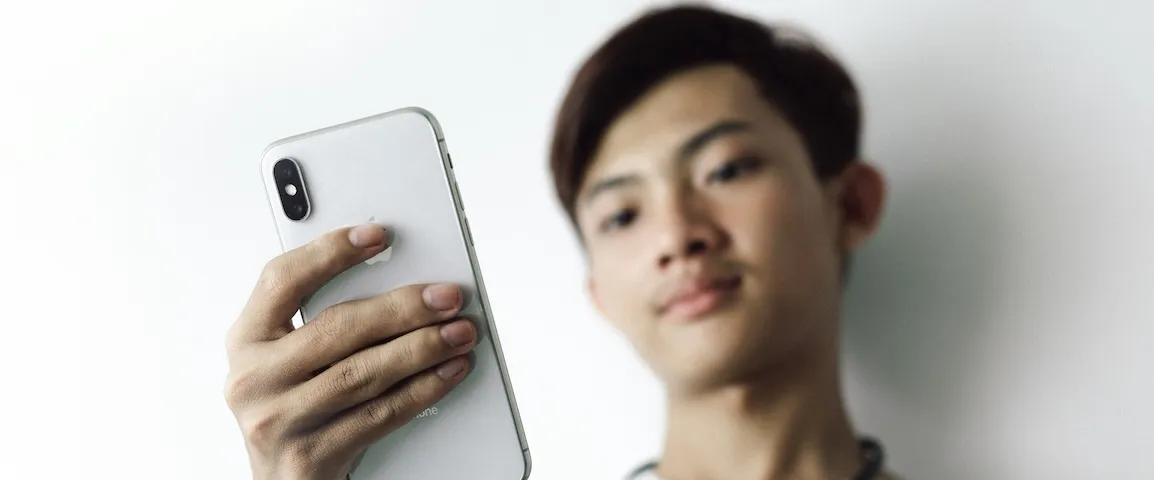
If you’re applying for a Schengen visa, you must submit a visa photo as part of your application. This photo can’t be any photo you want; it has to be one that meets specific biometric requirements in order to be compliant. A non-compliant photo can cause your application to be delayed if you need to submit a new image, or even rejected. This guide explains what the requirements are. Keep in mind that a compliant photo is only one of the Schengen visa requirements.
Schengen visa photo requirements at a glance
For short-stay Schengen visa applications (Type C), your photo needs to meet the following requirements, regardless of whether you’re traveling for tourism, to visit family and friends, or business.
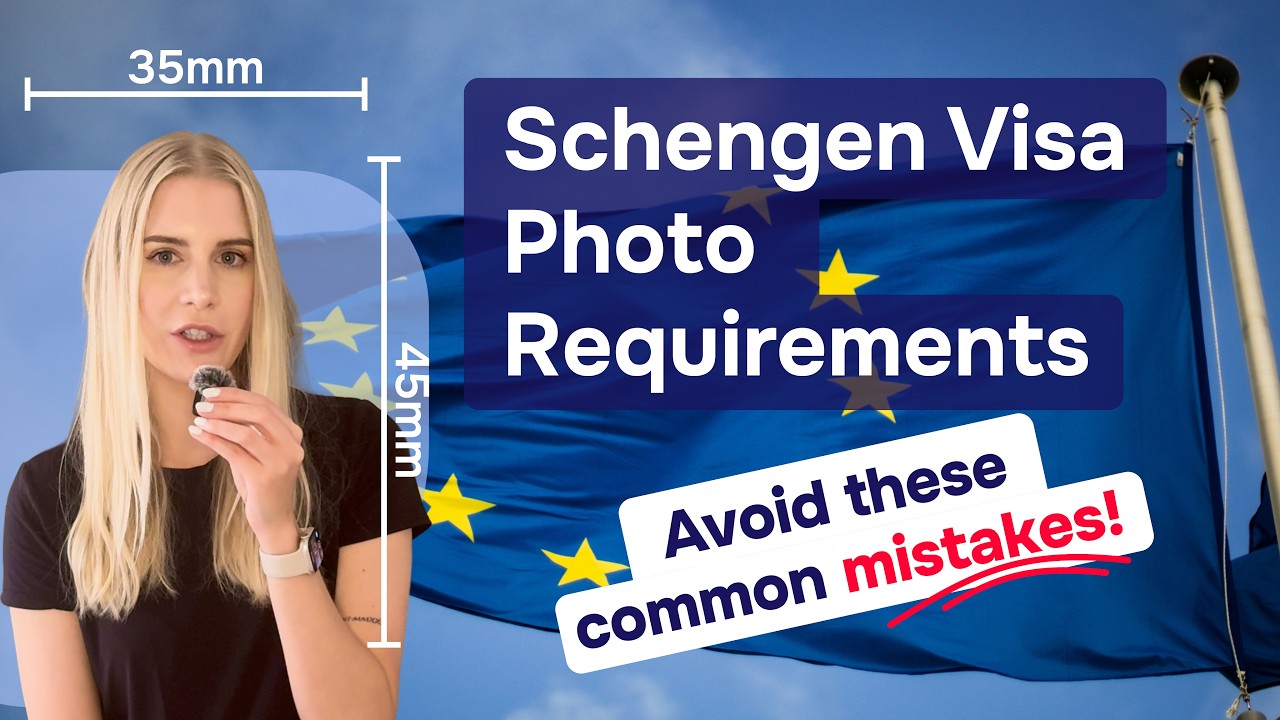
- Photo size: 35 x 45 mm (that’s about 1.38 x 1.77 inches)
- Photo age: taken within the last 6 months
- Face size: approximately 70-80% of the photo
- Background: plain and light-colored
- Expression: neutral, with your mouth closed
- Eyes: open, clearly visible, and looking directly at the camera
- Position: face the camera directly with your head straight
- Lighting: even, with no shadows, flash reflections, or red-eyes
- Image quality: sharp, clear, and in natural color
- Head coverings: not permitted except for religious reasons, with the face fully visible
Always check the official consulate, embassy, or visa application center website of the country you’re applying to and follow their specific instructions for your application, including any photo requirements they stipulate.
Watch our helpful video on the requirements
What size photo do you need for a Schengen visa?
Schengen visa photos should be 35 x 45 mm (about 1.38 x 1.77 inches). This is particularly important to pay attention to if you’re applying from the US, as a standard US passport photo measures 51 x 51 mm (2 x 2 inches). This means that if you go somewhere to get your passport photo taken (such as Walgreens) and select “passport photo”, it won’t be the right size by default.
Additionally, your face should take up 70-80% of the whole photograph.
| Feature | Schengen visa photo requirement |
|---|---|
| Photo size | 35 x 35 mm (~1.38 x 1.77 inches) |
| Face coverage | 70-80% of frame |
| Photo age | Taken within the past 6 months |
| Background | Plain, light colored |
| Expression | Neutral, mouth closed |
| Eyes | Open, clearly visible (no red-eye) |
| Image | Sharp, clear, in natural color |
Schengen visa photo specifications
The Schengen visa photo is a passport-style portrait. The purpose of it is to show and verify the identity of the visa-holder (you). This means that the photo you include in your application should represent your current appearance. That’s one of the reasons why the photo needs to be recent, so it’s easy for border authorities and other officials to match the photo with your physical appearance.
Face and head position
The photo should show you looking directly into the camera with your head straight and centered. Both sides of your face need to be equally (and clearly) visible. Make sure that you don’t tilt your head to either side, or up, down, or away from the camera at all. Your eyes need to be open and clearly visible, without any hair covering them. If you have long bangs, it might be helpful to pin them back, or at minimum push them out of the way for your photo.
Facial expression
While in some cultures it’s almost second nature to smile at the sight of a camera, you don’t want to do this when taking your visa photo. In a Schengen visa photo, your expression should be neutral with your mouth closed – no teeth showing.
Photo background
The background needs to be plain and light-colored. There shouldn’t be any patterns like wallpaper, objects (like windows or curtains), or any other people in it. This is the case even if you blur it. There needs to be enough contrast between yourself (face, hair, clothing, etc.) and the background for you and your identifiable features to be visible.
Lighting and shadows
The lighting should be even. Avoid:
- Shadows across your face
- Shadows behind your head
- Reflections from the flash being used
- Red eyes
- Overexposure or underexposure
Your natural skin tone should also be accurately represented.
Photo quality
Your photograph needs to be:
- Sharp and in focus (but not overly sharpened in an editing tool)
- In high resolution (not blurry)
- In natural color (no high saturation, etc.)
- Free from filters
- Free from creases, marks, or visible damage
If you're taking the photograph yourself, use high-quality photo paper. If you get your photo done professionally, make sure you specify it’s for a Schengen visa application.
Can you wear glasses in your Schengen visa photo?
There isn’t a strict rule saying you can’t wear them. That said, your eyes need to be completely visible, without reflections or glare. Tinted lenses, lenses that are thick, and many frame styles can obscure your eyes, rendering the photograph non-compliant. When in doubt, remove them. Tinted glasses and sunglasses shouldn’t be worn, since they block your eyes.
Can you wear a Hijab or other religious head covering?
Yes, religious head coverings are allowed in Schengen visa photos. Still, your facial features need to be clearly visible from the top of your forehead to the bottom of your chin, and completely from side to side. Head coverings where only your eyes are visible are not permitted.
Head coverings worn for fashion or any non-religious purposes aren’t allowed and need to be removed before your photo is taken.
Are Schengen visa photo requirements the same for every country?
Schengen countries all follow ICAO standards; however, there may be specific instructions issued by specific countries or even specific consulates. You should look up the guidance given by your destination to ensure that you provide a compliant photo.
For example, if you are applying for a Schengen visa for France, follow the guidance from France-Visas (the official site) or their official visa processing partner (such as TLScontact). Specific instructions and checklists from consulates and partnering visa processors should always take priority over any general guidance that you find online or elsewhere.
How many photos do you need for a Schengen visa?
How many printed photographs you need to include in your application can depend on the country you’re applying to and the specific process. Generally, 2 are required, but pay attention to what your consulate/visa center asks.
The number of printed photographs requested can depend on the country and application process. Some applications request two recent photographs, but do not assume that every application center follows exactly the same submission procedure. Check your official document checklist before your appointment and bring the number requested by the relevant embassy, consulate, or visa application center.
Where to Get a Schengen Visa Photo in the USA
Applicants applying in the US need to be particularly conscientious because American passport photos are different dimensions. You may be able to get a compliant photo from:
- CVS;
- Walgreens
- Professional passport/visa photo studios
- Some visa application centers or consular offices
Make sure the photographer knows that you need a European/Schengen visa photo, not a standard US passport one. Let them know about the size requirements, just in case.
Can you take your own Schengen visa photo?
There aren’t any restrictions on taking your own photo, but it does need to be high-quality and meet all of the specifications. If you decide to take your own photo, make sure you’re standing in front of a plain, light colored wall with even, bright natural light. Position the camera at eye level and look directly into the lens.
There shouldn’t be any shadows behind you, and you shouldn’t use any strong editing like beauty filters, portrait effects, or AI generation. After you’ve taken the photo, crop it and print it according to the specifications given to you or detailed by your visa application center or consulate.
Schengen visa photos vs US passport photos
These two photographs can look similar, especially at just a glance, but there are a couple of small differences (notably, the sizes) to pay attention to.
| Feature | Schengen visa photos | US passport photos |
|---|---|---|
| Size | 35 x 45 mm (~1.38 x 1.77 inches) | 51 x 51 mm (2 x 2 inches) |
| Format | Rectangle | Square |
| Face | Centered and clearly visible | Centered and clearly visible |
| Expression | Neutral, mouth closed | Smile ok, mouth closed |
| Background | Plain/light | White/off-white |
| Recent photo | Required | Required |
Make sure you don’t submit a photo designed for a passport in lieu of the rectangular visa one.
Common Schengen visa photo mistakes
Before you go to your visa appointment, double-check your photo for these common mistakes:
- The wrong photo dimensions (shouldn’t be square);
- Photo older than six months;
- You’re smiling or exposing your teeth;
- Your head is tilted or turned;
- Your eyes are closed, red (from camera effects), or not visible;
- Your glasses are causing reflections;
- Your hair is covering your eyes
- There are shadows on your face or in the background;
- The background is busy or dark;
- Poor resolution or blurred image;
- Filters or excessive retouching have been used;
- The print-out is damaged (torn, ripped, bent, etc.);
- You’re wearing a non-religious head covering;
- You’ve accidentally used the standard US 2 x 2-inch passport photo size without checking its dimensions.
What happens if your Schengen visa photo is rejected
If there’s a problem with your photograph, it doesn’t necessarily mean that your application will be immediately refused (though it can be). Depending on the situation and the authority that’s reviewing your application, you may be asked to provide a new photo that is entirely compliant. If you’re asked, this will delay processing, as they won’t be able to proceed with your application until the new image is received. This is why it’s better to check ahead of time before you go to your appointment and before you submit your documents. That said, some visa application centers and consulates may offer visa photo services. If this is the case, your photo will be taken and printed out during your appointment, which means you won’t be expected to bring one with you. Note that there’s typically an additional fee for services like this, if and when they’re available.
If the embassy does ask you for another image, make sure to follow their instructions on how to submit it, and that you do so within the deadline they provide you with.
Schengen visa photo requirements checklist
✓ Recent photo
✓ Correct dimensions for your application
✓ Face occupies approximately 70-80% of the image
✓ Head straight and centered
✓ Eyes open and visible
✓ Neutral expression
✓ Mouth closed
✓ Plain, light-colored background
✓ Even lighting
✓ No shadows or red-eye
✓ Sharp, high-quality image
✓ No filters or digital alterations
✓ Correct number of printed copies
Your printed photo is only one part of your application. You’ll also need to meet all of the other Schengen visa requirements, including travel medical insurance requirements.
Frequently asked questions
 Sources & references
- Internal Expertise & Review
- For the past 15+ years, our team has been helping travelers confidently visit Europe and around the world. We're dedicated to providing information on European travel and entry requirements in an easy-to-understand format.
- Schengen Visa Application Requirements:
- Schengen Visa Requirements : Requirements from the Austrian Embassy in London, England
- ICAO Standards : ICAO Standards for Schengen visa photographs as per the Italian consulate in Houston
- Written by:
- Sarah Pardi - Staff Travel Advisor
- Fact-check and reviewed by:
- Clément Goubon
- Last updated:
- September 29, 2026
Learn more about our editorial standards and review process in our Editorial Policy.