

Home > Travel Guide > Travel Planning > The Most Walkable European Cities for Car-Free Travel
Share this post
All cities in Europe are walkable because, historically, people had to keep daily life within walking distance.
For centuries, European cities had to fit within defensive stone walls, so residents lived, worked, shopped, and met each other within compact neighborhoods.
In the mid-20th century, many countries embraced mass car production and built highways and car-dependent suburbs. But multiple cities in Europe chose differently. They protected their historic cores, pedestrianized key streets and invested heavily in public transport.
After navigating dozens of European capitals on foot, I've learned that a true walkable city is one built for humans, not vehicles. In my book, it means safe pedestrian infrastructure and seamless public transport.
If you want to travel Europe without a car, these are the cities where the locals do it every single day. Just make sure you pack these European travel essentials, including a comfortable pair of shoes, before hitting the cobblestones.

Paris, France
Paris might be a sprawling metropolis, but it is one of the most walkable cities in Europe. And not by accident.
Paris protects walkability through its "15-minute city" concept by limiting car dominance, preserving its compact neighborhood structure, pedestrianizing key streets and investing heavily in cycling and public transit so residents can meet daily needs close to home.
In Paris, including the Petite Couronne, its first ring of suburbs, residents rely more on public transport than on cars, with 45% choosing it for work trips compared with 33% who drive, according to a GPS mobility survey conducted by L'Institut Paris Region.
For shopping, leisure and personal errands, 44% of Parisians choose walking, along with 33% of residents in the Petite Couronne.
Cycling has also become a major part of mobility in Paris. Parisians make 30% of all bike trips in Île-de-France, and they now use bicycles more than cars.
The city now has more than 1,000 kilometers (621 miles) of cycling routes. Its 2021–2026 bike program commits more than €250 million to develop its cycling infrastructure further.

Barcelona, Spain
In Barcelona's wider metropolitan area, 48.3% of trips are made on foot, 18.2% by public transport and 33.5% by private vehicle, according to the 2024 EMEF (Enquesta de Mobilitat en Dia Feiner) mobility survey.
While Barcelona's urban design naturally favors walking thanks to its compact grid and vibrant street life, the city has actively strengthened walkability through its innovative Superblock (Superilla) model.
The model groups nine city blocks into one larger block, where cars can only drive on the outer streets, and the interior streets are reserved for pedestrians, cyclists and local access.
Are You Covered Yet?
If you're heading to Europe, make sure you have the coverage you need.
The Sant Antoni Superblock is one of the closest examples to Barcelona's historic center, as it sits about 10–15 minutes on foot from La Rambla, right next to El Raval and the Gothic Quarter.
The World Health Organization (WHO) found that in the Sant Antoni superblock, NO₂ pollution dropped by 25% and PM10 particles by 17% after it became a Superblock. Residents also reported reduced noise pollution and improved well-being due to lower traffic levels.
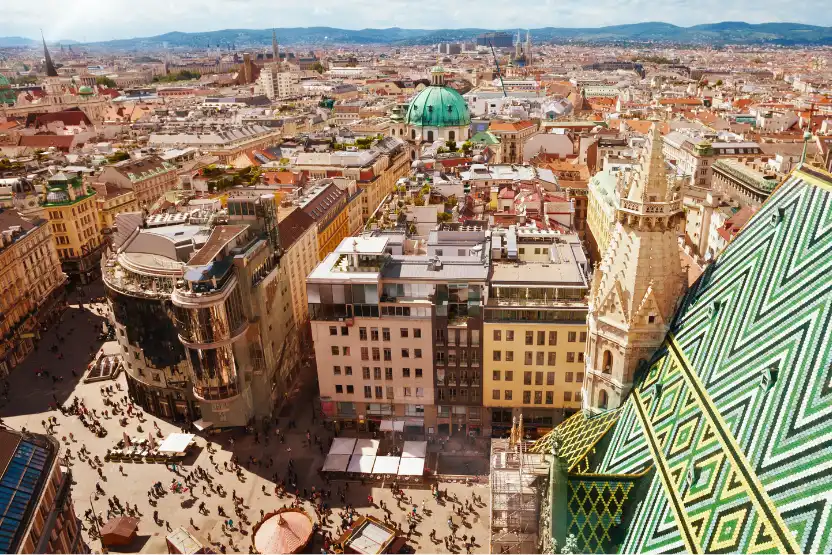
Vienna, Austria
Vienna built an extensive public transit network called Wiener Linien, that 90% of residents are satisfied with. It operates around 84 kilometers of underground lines, 171 kilometers of tram lines, 893 kilometers of bus routes and 110 U-Bahn stations.
75% of trips by Viennese residents are made by public transport (34%), on foot (30%) or by bike (11%), according to an official statement from Vienna Town Hall. Only 25% of the trips were by car.
Vienna is constantly expanding its pedestrian zones, which reached about 383,000 square meters in 2023, an over 14% increase in the last 10 years.
As of November 2024, 95% of Vienna's bus and tram stops were fully accessible, making it one of the most accessible cities in Europe.
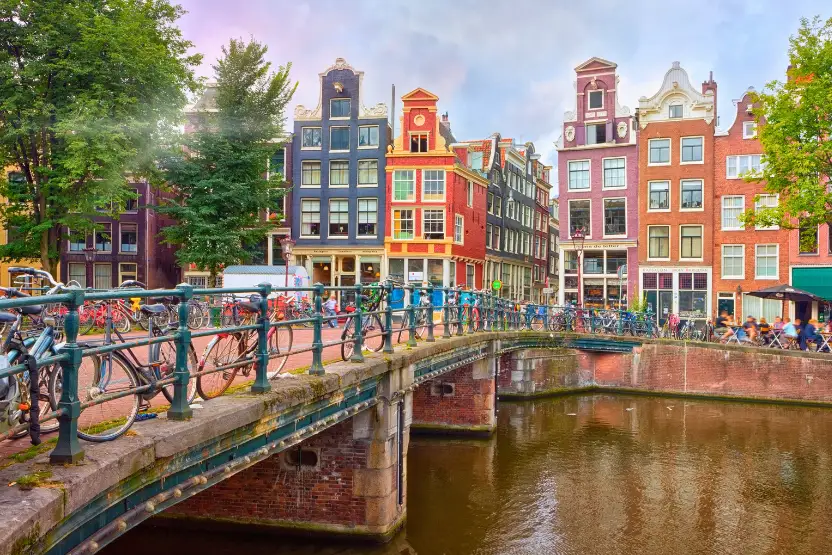
Amsterdam, Netherlands
Amsterdam might be world-famous for its bicycles, but the city treats "cars as guests."
Amsterdam's narrow historic streets and extensive canals leave limited room for walking, cycling, driving or even public transport. However, the city also needs them for rubbish bins, restaurant terraces and urban green spaces.
While cycling receives most attention, Amsterdam's street design also benefits pedestrians. Its Room for Pedestrians policy aims to redesign the city with humans in mind.
The city supports walkability with a network of more than 767 kilometers of cycling infrastructure and over 1,200 bridges connecting neighborhoods across its canals.
Amsterdam's public transport network is extensive and well integrated with walking and cycling. 5 metro lines, 15 tram lines and about 30 bus routes carry passengers between the historic center and the outer districts.
While the canals play only a small role in everyday life, the ferries, canal buses, and water taxis give tourists more ways to get around car-free.
Combined with relatively low car ownership, Amsterdam records about 35% of trips by bicycle, 25% by private vehicle, 23% on foot and 16% by public transport.
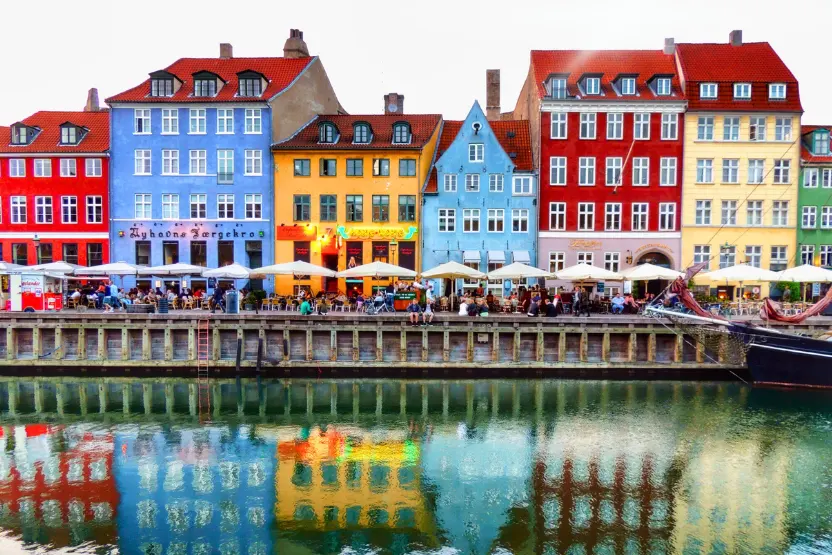
Copenhagen, Denmark
Copenhagen's mobility plan aims to have at least 75% of all trips made on foot, by bicycle, or by public transport, while car trips should account for no more than 25%.
To reach this goal, the city focuses on improving traffic management so pedestrians, cyclists and buses move efficiently through the city.
After identifying safety as a key barrier to getting people out of their cars, Copenhagen introduced multiple measures, including curb-protected bike lanes, wider crossings, and raised platforms to provide safe walking conditions in areas with heavy foot traffic.
Copenhagen also supports walkability with a large, well-connected public transport system that includes buses, harbour buses, the Metro, S-trains and regional trains. The Metro alone has four lines, 44 stations and 43 kilometers of track, with easy transfers to S-trains and regional rail.
Traveling in Europe Without a Car? Easy and Cheap
Wherever I travel in Europe, I never use a car or taxi to get around and explore the city. I find it not only easier and cheaper, but it also saves me from worrying about rental fees, fuel costs, unfamiliar traffic laws and parking hassles.
Consider the European high-speed rail network as your best friend. Not only is it easier than flying, but choosing between planes or trains in Europe drastically reduces your carbon footprint.
Traveling by train through Europe means you can skip the airport-related hassles and start exploring on foot immediately. You can walk out of your hotel in central Paris, hop on a train, and arrive right in the heart of Amsterdam or Vienna a few hours later, ready to walk.
Related posts




Upcoming travels ? Get Insured !
Find the right insurance for your trip by using our powerful comparison tool!
Emese Maczko - October 20, 2026
Emese Maczko - October 9, 2026
Emese Maczko - September 2, 2026