

New Tourist Taxes in Europe 2026: What Every Traveler Needs to Budget For This Summer
Emese Maczko - June 2, 2026
Home > Travel Guide > Travel Planning > New Tourist Taxes in Europe 2026: What Every Traveler Needs to Budget For This Summer
Share this post
If you are planning a European vacation for the summer of 2026, the cost of your plane ticket and hotel room is no longer the final tally. Popular European destinations are pushing back against the strain of mass tourism with targeted levies, surcharges, and green taxes.
For an average family trip to a European hotspot, these taxes can quietly add hundreds of euros to your total holiday budget. Here is the exact, destination-by-destination breakdown of the new European tourist taxes you must budget for in 2026.
Why Europe Is Introducing More Tourist Fees In 2026
Europe welcomed a record number of visitors in 2025, nearly 3.1 billion nights spent in the European Union, a 2.2% increase compared to 2024.
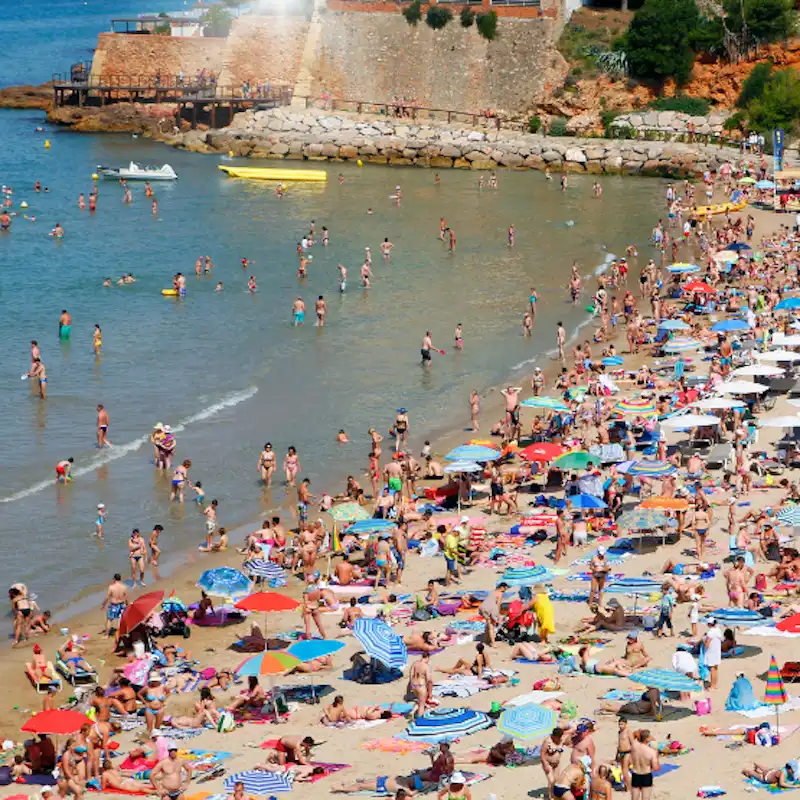
Many popular European destinations are increasingly struggling with housing shortages due to short-term rentals, crowds at famous landmarks, rising preservation costs, environmental strains, and growing resident backlash against mass tourism.
I remember last year's water gun protests in Barcelona, seeing graffiti saying 'tourists go home' in Venice, or the overwhelming crowds photographed in Positano recently, even before the summer season had officially begun.
It is no surprise that many governments have introduced different levies, surcharges, and taxes to cover costs and control crowds. A trend that does not seem to stop in 2026.
New European Tourist Taxes, Fees and Surcharges In 2026
| Destination | When | Tourist Tax | Notes |
|---|---|---|---|
| Amsterdam, Netherlands | In effect | 21% | Europe's highest tourist tax |
| Bucharest, Romania | In effect | 10 lei (~€2) | New tax |
| Brussels, Belgium | In effect | €5 (hotels), €4 (campsites, homestays) | €1 raise for hotels & serviced accommodations |
| Iceland | In effect | from 6.95 ISK per kilometer | Road-based, not overnight stay-based |
| Catalonia, Spain | In effect | Increases across the board, see details in section below | Tax will continue to rise in the coming years |
| Milan, Italy | In effect | €3 - €12 per night, accommodation depending | Tax raised for Winter Olympics, then kept |
| Venice, Italy | Between April 3 and July 26 | €5 (pay in advance), €10 (pay on-site) | Day visit fee; overnight guests exempt |
| Norway | July 1, 2026, but no payment until 2027 | 3% (overnight stays). Cruise tax proposed. | 5% (pre-VAT room rate) |
| Scotland | July 24, 2026 | 5% (pre-VAT room rate) | Only for first 5 consecutive nights |
Amsterdam, the Netherlands
Amsterdam has already levied Europe's highest tourist tax (a flat 12.5% of the room rate), but on January 1, 2026, the city became even more expensive. The VAT on short-stay overnight accommodations jumped from 9% to 21% for this year for short-term rental owners.
Bucharest, Romania
Romania became the first European country to introduce a new tourist tax in 2026.
The General Council of the Municipality of Bucharest introduced a new flat rate as of January 1, 2026. Visitors have to pay 10 lei (approx. €2) per night, regardless of whether they stay in a luxury hotel or a hostel.
Brussels, Belgium
Brussels is among the first European cities to increase its tourist tax for 2026, although the adjustment is relatively modest.
From January 2026, the Belgian capital raised the tourist tax from €4 to €5 per night for hotels and serviced accommodation, while keeping the tax for homestays and campsites at €4 per night, the same as last year.
Iceland
While Iceland is not introducing a new traditional overnight tourist tax in 2026, it is instead shifting to a tax on road usage.
On January 1, 2026, Iceland replaced its fuel tax with a per-kilometer road usage charge that applies primarily to rental cars used by visitors. The fee starts at 6.95 ISK per kilometer and it is typically collected automatically by rental companies.
Catalonia, Spain
Travelers planning a trip to Spain will also face higher taxes. As of 2026, only a few Spanish regions charge a tourist tax: Catalonia, the Balearic Islands, and the cities of Santiago de Compostela and A Coruña in Galicia. Starting April 1, 2026, Catalonia's tourist tax will rise sharply.
This summer, visitors staying in five-star hotels will pay €7 per person per night under the standard rate and €10 under the special rate, compared to €3-€4 before.
Travelers staying in mid-range 4-star hotels will pay €3.40 under the standard rate or €7 under the special rate, and in tourist apartments, €4.50. Lower-tier accommodation, such as youth hostels and campsites, is taxed at €1-€2 per person.
Cruise passengers will also face charges of €4 for stays over 12 hours and €6 for shorter stays.
Outside Barcelona, the rest of Catalonia also sees a substantial increase, with 5-star hotels rising to €4.50 per night in 2026 and further to €6 in 2027. Mid-range hotels increase to €1.80 in 2026 and €2.40 in 2027, while tourist apartments rise from €1.75 to €2.50 over the same period.
Cruise passengers will face €3 in 2026 and €4 in 2027.
However, this is not all. There is a municipal surcharge, which has been around €4 per person per night until now. In 2026, Barcelona will add €5 to the tourist tax, then gradually increase it each year until it reaches the legal maximum of €8 per night by 2029.
Milan, Italy
Milan increased its tourist tax in 2026 ahead of the Winter Olympics. While the Games are over, the tax remains.
As of April 1, 2026, rates range from €3 per night for one-star hotels, up to €12 per person per night for five-star hotels and luxury guesthouses.
Open-air facilities and youth hostels will charge visitors €3 per night, while holiday homes, guesthouses, inns, bed & breakfasts, and short-term rentals will levy a higher flat rate of €7 to €9.50 per person per night.

Venice, Italy
How Venice manages overtourism is closely watched from across Europe. For 2026, the city extends its day-tripper access fee to around 60 peak days between April 3 and July 26.
Visitors entering the historic city between 8:30 a.m. and 4:00 p.m. without an overnight stay must pay between €5 (for advance payment) and €10 (for last-minute payment) per person.
Overnight guests are exempt from the fee, but they must still register to obtain an official 'Exemption QR Code' before arrival. A hotel confirmation is not sufficient. Failure to present the QR code at control points can result in fines of up to €300.
Remember that when authorities scan your QR code, they may also ask for identification. Be sure you know which European countries legally require you to carry your physical ID at all times.
Norway
If you are traveling to Norway this summer, the new tourist tax law is technically effective as of July 1, 2026, but your wallet is safe until 2027.
The Norwegian Parliament passed a law that allows municipalities to apply a 3% tax on overnight stays and a cruise fee (proposed at NOK 100) for day-trip cruise passengers, but only if they can demonstrate that tourism is straining local infrastructure.
Municipalities must apply to levy the tax and the cruise fee. Since none have yet gone through the approval process, no tourist tax will be collected during the summer of 2026. Tromso, Lofoten and Svalbard are the most likely candidates for first implementation.
Scotland, United Kingdom
Edinburgh launches Scotland's first 'visitor levy' as of July 24, 2026. Travelers will pay a fee equal to 5% of the pre-VAT room rate per night, capped at the first five consecutive nights of a stay. Extras such as parking or meals will not be part of the fee base.
Understanding Europe's Push for Tourist Taxes
Europe is full of walkable cities where daily life and tourism overlap so closely. Residents and travelers share the same narrow streets, squares, and public spaces.
Before saying the tourist taxes in Europe are too high, consider the local people and what they have been feeling as they see their beloved cities, towns, or neighborhoods flooded with tourists to the point where they can no longer comfortably go out onto the streets themselves.
If you are looking to avoid the crowds in Europe, you should know that choosing the right destination at the right time can make all the difference.
Tourist taxes also help offset the environmental toll of millions of visitors. If you want to reduce your impact proactively, here are a few simple ways to lower your carbon footprint while traveling in Europe.
Related posts




Upcoming travels ? Get Insured !
Find the right insurance for your trip by using our powerful comparison tool!
Emese Maczko - October 16, 2026
Emese Maczko - October 9, 2026
Emese Maczko - September 2, 2026