

Moving to France from the US: The Complete Expat Guide (2026)
Sarah Pardi - October 28, 2026
Home > Travel Guide > Travel Requirements, Policy & Authorization > Moving to France from the US: The Complete Expat Guide (2026)
Share this post
People all over the world fantasize about moving to France – the most popular destination in the Western world. Paris, Lyon, Bordeaux, Nice… those are just a few of the historic cities around the country. A lot of Americans are wondering if they can move to France. Is it possible? Is it easy? Are there specific eligibility requirements, and what does the process actually look like?
Is moving to France a realistic option for Americans?
| Yes! Americans can move to France, so long as they go through the applicable visa process and are approved. Thousands of Americans move to France each and every year. |
This guide (written by an American who moved to France) is here to help you understand what options exist, the process, and things you’ll need to know before and during the immigration process. France allows Americans to move legally, and there are several different pathways that you can take. At the heart of moving to France is the visa. It’s absolutely necessary, and there are different types available for different kinds of people and situations. There are other requirements too that depend on the visa type, like travel insurance.
Moving abroad is rarely easy. There are so many different things you have to consider, on top of the logistics, like finding a visa type that works for you, going through the process, and getting approval. Doing research ahead of time is the best thing that you can do to prepare, because there will be a lot of moving pieces if you decide to uproot your life. Even with everything you need to do, it’s achievable, and thousands of US citizens go through the process and make their roots on French soil every single year.
This guide covers:
- French visa options
- French citizenship opportunities
- Cost of living in France
- Renting/buying property
- Finding housing
- Opening a bank account (it’s not as straightforward for Americans)
- French healthcare
- The best cities to move to
- Speaking French
- FAQs
French visa options for US citizens
We recommend you review our French Long Stay Visa & Residence Guide for a more detailed look at the process.
Most Americans who move to France get a long-stay visa (VLS-TS). This is a type of visa that doubles as a residence permit. When you get a VLS-TS, you establish residency within a certain timeframe once you’ve arrived. Some visas, on the other hand, require you to go to the prefecture (the local government office) and apply for a residence card when you arrive. A VLS-TS is both your long-stay visa and a temporary residence permit, giving you a bit more time and flexibility for your first few months in the country.
There are different types of long-stay VLS-TS visas depending on your situation and what you want or need to do while living in France as an American expat. For example, not all VLS-TS visas allow you to go to school and study. Not all allow you to work and make an income.
If you’re considered a skilled worker or entrepreneur, there is a category of visas called Talent Passports. There are different types for different kinds of workers (someone who works for start-ups, artists/musicians, highly qualified individuals, etc.). This is a common visa type to explore, as when you have one, it gives you the right to do specific types of work. Some of the categories include:
- For employees: Working for a “new innovative enterprise” (a start-up, essentially)
- For employees: If your current company has a branch or HQ in France
- For employees: You’re a highly qualified employee
- For employees: Public or private research
- For employees: Higher education organizations
- For employees who are performers: You’re a performer and are employed as one
- For the self-employed: You’re creating a business in France
- For the self-employed: You’ve purchased and/or are taking over a business in France
- For the self-employed: You’re going to work on an innovative project that is recognized by a public body
- You are a self-employed performer
- For the self-employed: You’re making a direct economic investment
- For someone with notoriety: You’re nationally or internationally recognized, and it’s relevant to your reason to move to France
These aren’t the only options available to Americans, even in the Talent Passport visa category, but they give you an idea of how many options there are for very specific situations and scenarios.
If you’re a student and want to either carry on your studies in France or continue your education, there are options, too. There is a VLS-TS student visa, where your long-stay visa doubles as a temporary residence permit. This visa also allows you to work part-time to help fund your stay, without having to apply for another kind of work permit.
The application process, regardless of which visa you’re applying for (and there are more than what’s listed above), is the same. You need to figure out which visa is best for your situation and what you plan to do in France, whether that’s work, study, retirement, etc. Once you know which visa is the best for your situation, you can start the actual application process. Americans apply for French visas through France’s official partner, TLScontact. TLScontact is a visa processor, meaning they facilitate the visa process on behalf of the French government. This means you don’t book an appointment at the embassy or consulate and apply – you go through TLScontact.
Still, you need to start on an official French website: France-Visas. It used to be called the Visa Wizard, so you may see that term floating around in older guides and blogs. You’ll create an account on France-Visas and follow all of the prompts there. You’ll be given access to an official checklist that tells you what the specific requirements are for the visa you want to apply for. When there is a requirement (such as proof of funds, for example), there is documentation you will need to submit to prove that you’ve met it. Applying means gathering all of the requested documents, which can include your passport, bank statements, employment contracts or letters, business registration documents, tax documents, birth certificates, marriage certificates, diplomas or transcripts, and more. Different visas have different requirements.
Once you have started the process on the France-Visas website, you will be able to book an appointment with TLScontact at a regional branch near you.
Appointments are currently mandatory for long-stay visa applications. This means that you will need to book an appointment and attend it, which could mean you need to travel out of town. You’ll bring all of your documents to the appointment, as well as anything else they’ve requested. There, they’ll review your file to make sure everything they need to see is present. If your file looks complete and ready to submit, they will submit it for you, and it will get forwarded to the French Embassy in Washington, DC, where a visa officer will manually review your application and decide whether or not it’s approved or denied. The lead-up to the appointment can take weeks or even months, but once the application has been submitted by TLS, processing times can be fairly quick, around 15 days, but it can take longer.
Once approved and in France, there is still more you need to do. If you have a VLS-TS, you have a bit more time to establish residency than other visa types. French residents have to have a titre de séjour (residence permit). Your visa and your titre de séjour aren’t the same thing at the end of the day. A VLS-TS can act as your residence permit temporarily, but for those really looking to move long-term, you will need to eventually get a Carte de Séjour. A Carte de Séjour is an ID card that is your residence permit. However, different cases can be unique and specific, so always follow the information and advice you’re given from TLScontact, France-Visas, and the French Government and Prefecture.
Can you get dual US-French citizenship?
Whether or not you can have dual citizenship, in general, depends on both of the countries you want to be a citizen of at the same time. The US allows dual citizenship, and so does France. This means that yes, you can legally and technically have dual citizenship. Some countries don’t allow dual citizenship. For example, Japan doesn’t.
There are a couple of ways that a US citizen can become a French one. The most common is through naturalization. Foreigners who have lived in France legally for 5+ continuous years and can prove advanced intermediate French language proficiency (B2) can apply for citizenship. It isn’t as simple as emailing the prefecture and asking, or filling out a form. It’s a long process, taking several years, and requires documentation, appointments, language and history tests, and more. University students have a shorter “naturalization” period, as do foreign spouses who are married to French citizens, but the process is still lengthy and detailed.
How much does it cost to live in France? (2026 breakdown)
The minimum wage in France is €1,478 net per month for a single, full-time employee. Whether or not you can live comfortably on this minimum depends on where you’re choosing to live and the lifestyle that you want to have. Paris on under 1.5K a month looks a lot different than a small, rural town on 1.5K a month.
It’s not as straightforward to put a table together that says how much it costs to live in France, because there isn’t any sort of standardized number. Plus, living in a big city like Paris is usually notably more expensive than living somewhere smaller. For instance, rent prices could be double in central Paris than they are in the suburbs even.
Here is a list of the average rental cost for Paris (by administrative zone) according to the most recent data from the French government (OLAP).
We took a look at the average rental cost for Paris according to the most recent data from the French government (OLAP). The data is by square meter and by administrative zone, but we put it into this table to help you get an idea of what you could expect to find as far as rental prices go. Keep in mind that these are averages, so real prices can be lower or higher.
| Zone & Arrondissement | What it's Near | Monthly Rate (500 sq ft, unfurnished studio) |
|---|---|---|
| St-Germain-l'Auxerrois, 1st | The Louvre, Sainte-Chapelle, Pont Neuf, the Tuileries | ~€1,695.48 |
| Halles, 2nd | Les Halles, Châtelet | ~€1,588.64 |
| Saint Gervais, 4th | The Marais, the Seine, Saint-Paul | ~€1,662.96 |
| Arsenal, 4th | The Bastille, Place de Vosges, the Seine | ~€1,695.48 |
| Jardin-des-Plantes, 5th | The Jardin des Plantes | ~€1,532.90 |
| Sorbonne, 5th | The Pantheon, Shakespeare & Co, the Latin Quarter | ~€1,662.96 |
| Odeon, 6th | Jardin du Luxembourg, the Latin Quarter | ~€1,695.48 |
| Saint-Thomas-d’Aquin, 7th | The Bon Marché, Saint-Germain-des-Prés, the Musée d’Orsay | ~€1,676.90 |
| Gros-Caillou, 7th | The Eiffel Tower | ~€1,676.90 |
| Faubourg-de-Roule, 8th | The Arc de Triomphe and Champs-Élysées | ~€1,695.48 |
| Chaussée-d’Antin, 9th | The Palais Garnier | ~€1,695.48 |
| Montparnasse, 14th | Montparnasse Cemetery, the Catacombs | ~€1,588.64 |
| Clignancourt, 18th | Montmartre, Sacré-Cœur | ~€1,412.13 |
| Belleville, 20th | Belleville Park | ~€1,486.45 |
There are tools that you can use to compare cost-of-living between US cities and French ones. Numbeo is a site that collects user-submitted information. It takes the information and puts it into a format where you can see the difference in pricing, including things like rent, groceries, and utilities. For example, the total cost of living in Paris, France, is 41% lower than in New York City, according to user-reported data. You can also compare French cities to other French cities. Paris is the most expensive city in France, so if you’re flexible, it’s worth looking at other cities such as Lyon or Bordeaux, or even smaller ones like Rouen or Colmar.
While rent is usually the top cost once you’ve actually gone through the immigration process, flights, etc., it isn’t the only cost. Many Americans find utilities to be similarly priced, or even less expensive depending on where you live. Things like Wifi and cell phone plans are also less expensive than in the States. A phone plan might be $50 a month in the US, while the same plan could be 14 euros in France. Wifi might be $80 or so in the US, and in France, it might be 20 euros. How expensive something is is incredibly relative. If you’re coming from Manhattan, you’re going to have a different idea of what is expensive and what isn’t than if you’re coming from rural Ohio.
Healthcare, cost-wise, is a huge thing to consider. Those looking to move to France indefinitely are typically able to access the local healthcare system some months after moving (it can depend on your long-term plans and visa types, however). While healthcare in France is far less expensive than in the US, there are still costs to consider, and if you have a domestic-only US insurance plan, or Medicare/Medicaid, they can’t be used overseas. Many long-stay visa applications will require you to show that you have valid healthcare secured for a specific period of time. Others won’t, because they will assume you are going to enroll in the local system. Even though France’s public healthcare system covers many costs, it doesn't cover 100%.
How much money do you need in the bank to move to France?
When looking at how to move to France as an American, there isn’t a cut-and-dry figure, but you will need to show proof of financials in one way or another. What you need to show (in terms of figures and document types) depends on the type of visa you’re applying for. In some cases, such as for retired couples, for example, you may need to show that you have enough money to meet the minimum requirements set out by the French government. This could be through pension certificates, bank statements, passive income, or other liquid funds. For a young professional moving on a talent passport, you may only need to show your contracted salary in France (which almost always has to meet a minimum salary requirement, and it varies).
Additionally, the amount is influenced by the economy, so it does change from time to time. The best way to know exactly how much money you need in the bank account is to look at the requirements for the specific type of visa you want to apply for.
All of that said, the minimum monthly wage is €1,478 net, so you typically need to show that, at a minimum. But it doesn't mean that number alone will suffice. Follow the visa center/consulate guidance on finances.
It’s also worth knowing now that salaries are lower in France than they are in the US, even when you convert the currency. For instance, €50,000 a year is considered a very good salary in France, even in Paris, where prices are higher.
Cost of renting vs. buying property in France
Some people choose to flat-out buy an apartment or house when they move to France, rather than rent, but it is a good idea to look at both options before you make any decisions. Buying property in France doesn’t automatically allow you to stay in the country – visas are required, and owning property doesn’t mean your visa or future visa renewals will be approved or are more likely to be approved.
Average cost of rent per city, per square meter
| City | Price per Square Meter (rent) |
|---|---|
| Paris (excluding suburbs) | €27.30 / m2 |
| Paris suburbs | €18.30 / m2 |
| Lyon | €15.00 - €16.00 / m2 |
| Bordeaux | €12.80 / m2 |
| Nice | €15.00 - €16.50 / m2 |
| Marseille/Aix-en-Provence | €12.50 - €13.50 / m2 |
| Toulouse | €11.90 / m2 |
| Strasbourg | €11.60 / m2 |
| Lille | €11.50 - €12.50 / m2 |
| Nantes | €12.20 / m2 |
The table above shows averages, and the rent prices you see can vary. This data was captured in October 2026, so it will also change with the economy and potential inflation.
Foreigners can buy property in France, but you need to think about how you'll pay for it. Mortgages typically happen through French banks, not American ones, though there are international options you can consider. Then, for some, there’s always the option to buy right out, cash in hand. There are a few additional costs you need to also add to a price you see. In France, notaries are used, and these rates can be upwards of 7-8% or more.
Legal residents also have access to CAF housing assistance (Caisse d'Allocations Familiales). If you are in a situation where you need a little bit of financial assistance to rent, you can turn to them to learn what exactly your options are.

Finding accommodation in France as an American
It’s easier to find rentals in some places more than others. Paris is notoriously competitive, with a high demand and an insufficient supply to meet it. There are platforms where you can browse listings posted by independent landlords, housing managers, or agencies, but they’re public boards, so take the normal precautions you would on any public shopping site that allows user-posted listings. Some common French sites are LeBonCoin, SeLoger, and PAP.fr. There are even sites geared specifically towards expats, like Lodgis and Paris Housing, but the listings can come at higher costs. Jinka is an app that takes listings from several sites (like the ones above) and puts them all in one place, so that’s a popular option too. Another option is joining Facebook groups, but be vigilant because scams can (and do) happen.
The rental process is similar to the States, but with its own differences. While it can be first come, first served (and often is), it isn’t always. In the US, when you rent, the first qualified applicant typically has the right to rent. In France, it isn’t the case. The landlord can choose the application they feel is the best fit. In the US, you typically fill out an application form, provide proof of income, and your ID. In France, you need to include a lot more information than when you apply.
When you see a listing you like, you should reach out right away, preferably by telephone, because apartments get snatched up quickly. You can either submit your dossier (application) before you view it, or bring it with you to the viewing. The person showing the apartment might tell you which they prefer. The dossier usually needs to include a cover letter explaining your situation, your ID (passport and legal residence information), proof of income (3x rent), and a guarantor (a co-signer). Sometimes, proof that you’ve paid rent in the past (attestation de loyer) and tax information are also needed. You may see that you need a French guarantor, but legally, they do not have to be French.
In France, there are two types of rental units: furnished and unfurnished. This is different than the US, where the vast majority of apartments are considered unfurnished. There’s an additional layer in France, though. Unfurnished apartments don’t usually come with appliances (fridge, oven, washing machine, etc.), but furnished ones do. Furnished apartments typically have a higher deposit you’ll need to pay. They also have different contract terms. Furnished apartments have shorter contract periods than unfurnished ones.
Another thing that surprises Americans is that there is no “pet rent”. In France, pets are considered part of your “private life”, which means that landlords cannot ask you if you have pets, and you do not have to disclose if you do. If you have a cat, for example, you don’t have to “look for an apartment that allows cats”.
If you do have pets and plan to bring them with you, make sure you check out our pet guides: Long-term Travel with Cats and Long-term Travel with Dogs
A lot of expats and immigrants choose a temporary solution first, such as an Airbnb or other shorter-term rental. When you establish residency, you may need to have the same dedicated address for a specific amount of time, so make sure you check with the French government if you choose a short-term solution in the interim.

Opening a bank account in France as a US citizen
One thing that immigrants struggle with when getting to France is opening a French bank account. This is because French banks are required to report information on American clients to the IRS, which is another layer of administrative work on their part. So, some banks may tell US citizens that they’re unable to open a bank account there, or that opening an account can only happen at specific branches. This is because of FATCA, the Foreign Account Tax Compliance Act.
It’s worth looking at larger international banks like BNP Paribas, Societe Generale, and Crédit Agricole. There are also some popular FATCA-compliant online banks, such as Revolut that are popular.
Oftentimes, you need an appointment to open a bank account in France, but some companies and branches may offer walk-ins. To open an account, you’ll need specific documents like your passport, proof of residence (visa), and proof of address. Check which documents the specific bank you’re looking at requires. They're usually listed online.
Understanding French healthcare as an American expat
France has universal healthcare that its residents can access. Some visa holders can start the process on day one, while others need to wait at least three months before subscribing to it. In France, once you’re eligible, you need to register with your local CPAM (Caisse Primaire d’Assurance Maladie). This process can take 3 to 9 months or more to be completely registered, but your doctor can give you reimbursement sheets while you’re waiting for your Carte Vitale (the card you need to access the public health system).
Having a Carte Vitale allows you to get medical care reimbursed, but it isn’t 100% in most cases. It’s about 70% for general care, and 80% for inpatient hospital stays. This is the public system. If you’re working in France, your company will also offer you a Mutuelle. Mutuelle is health insurance that fills the gap (around 30%) and also includes coverage for things like dental and vision.
All of this said, many long-stay visa applications require you to have private health insurance (or travel insurance) when you apply, in order to cover you while you’re not covered by the public system.
The best cities in France for American expats
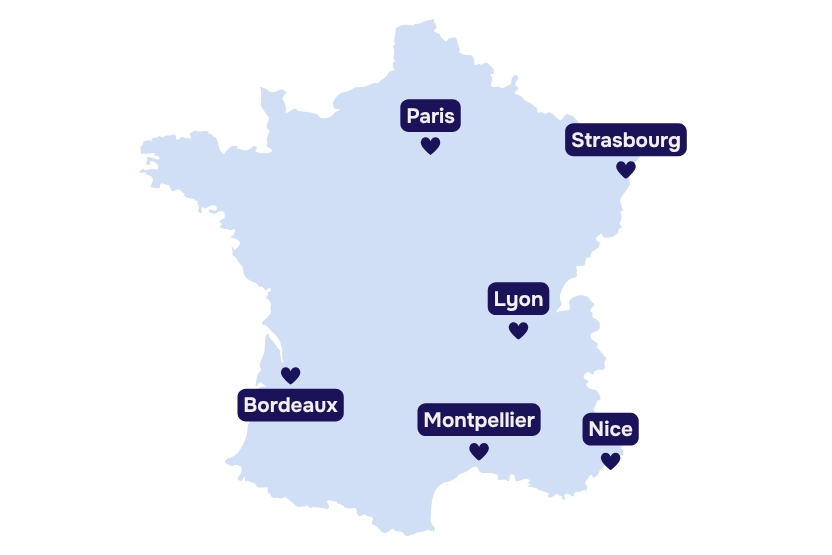
Paris is the most famous city in France, but there are so many others, too. Each of the cities listed below has an international airport, a well-connected train system, an English-speaking community, and offers a different vibe than the others.
| City | Population | Climate | Rainy Days per Year |
|---|---|---|---|
| Paris | 2.05M | Oceanic (cool, wet winters, warm summers) | ~109 |
| Lyon | 518K | Humid subtropical (mild winters, mild summers) | ~104 |
| Bordeaux | 267K | Oceanic (cool, wet winters, warm summers) | ~116 |
| Nice | 357K | Hot-summer Mediterranean (mild winters, hot summers) | ~63 |
| Montpellier | 310K | Mediterranean (cool, damp winters, hot, dry summers) | ~56 |
| Strasbourg | 293K | Oceanic (cool, wet winters, warm summers) | ~114 |
Paris
Paris is probably the first choice for most people. It’s a large, international city with pretty much any amenity you could want. It’s split up into 20 different arrondissements (this Paris City guide has a good explanation of some of the most popular), and each one has its own personality and feel. Living in the 17th is going to be a significantly different experience than living in the 6th, for example. One downside to living in Paris is that it isn’t only the most expensive city in France; it’s one of the most expensive cities in all of Europe. Still, it is less expensive than many major US cities like New York and Los Angeles.
Lyon
Lyon is another top choice. It’s still a large city with an endless list of things to do, but more affordable than Paris. Like Paris, though, there’s a large English-speaking population, which is helpful if you don’t speak French or are still learning the language. It’s also a really balanced city. There’s great food, art, and architecture, but also a modern tech scene. There are a lot of outdoor spaces, parks, and two rivers.
Bordeaux
Famous for producing some of the best wines in France, Bordeaux is an incredibly well-connected city that isn’t too far from the Atlantic Ocean. It is considered a world capital of wine and food, so there’s always something to try. Unlike some French cities, Bordeaux is quite flat, which makes it a bit easier to get around on foot or by bicycle.
Nice
Nice is incredibly sunny. The city sees around 300 days of sunshine annually. It's a coastal city on the Mediterranean, and its proximity to Italy influences its architecture, food, and way of living. Partially because it’s an internationally known resort destination, the city has a lot of English speakers.
Montpellier
Montpellier is incredibly youthful – much of its population is students. Like Nice, the city also sees a lot of sunshine, but with milder summers. Because it’s a big student hub, Montpellier is less expensive than Nice, which is great if you’re looking for a similar Mediterranean feel, but have financial constraints you need to keep in mind. There is also a huge pedestrian-only zone in the center of the city.
Strasbourg
Strasbourg is near Germany, and you can see the influence in the architecture and culture. In fact, many people in Strasbourg speak German. Strasbourg is famous for its world-renowned Christmas markets, as well as its vast cycling network. There are more than 600 kilometers of bike paths.
Do you need to speak French to live in France?
In some cities, and in some scenarios, it may not be required, but it will always make life significantly easier. Many visas/multi-year residence cards require you to have a certain (provable) level of French fluency. In this case, yes, you need to speak French, to some extent anyway.
For some visas, French lessons are required if you can’t pass a minimum language requirement. For other visa types, you may not have to take lessons, but to get multi-year residency, you may need to pass a test.
Large cities have English-speaking communities. Paris specifically has a huge tourism industry, so many waiters, store clerks, and other people do speak English to some degree.
However, when dealing with the government, admin, and day-to-day situations like setting up Wifi and calling the plumber, French proficiency is going to help you immensely.
Moving to France: Timelines and other tips
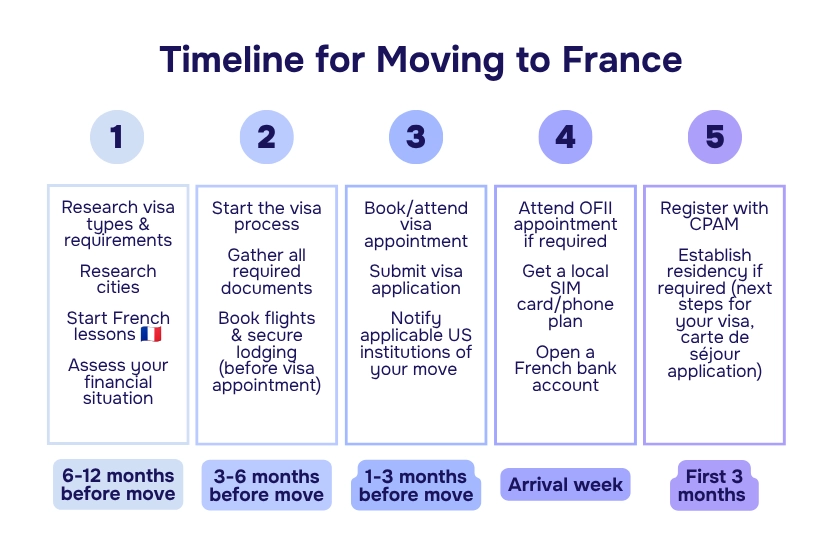
6-12 months before: Research visa types and requirements. Start French lessons, start looking at cities, and assess your financial situation. Consider whether you want to ship your items or buy new in France.
3-6 months before: Start the visa process. Gather the required documents, apply for a visa, research neighborhoods, and continue your French lessons. Book flights.
1-3 months before: Make sure you have a housing plan (before you submit your visa application), attend your visa appointment, notify any US institutions, and begin any bank applications if possible. If you're bringing pets, get the required immunizations/records and health exams (check with the French government/your airline for specific timelines).
Right before you leave: Convert your US phone number into a Google phone number (so you don’t lose access to important apps or accounts that require 2-factor authentication).
Arrival week: Get settled. Attend an OFII appointment if required (not all visa types require this; many do). Get a local SIM Card/phone plan and get your bank account open. Get familiar with your neighborhood.
First 3 months: Register with CPAM, search for a long-term housing solution, establish residency if required for your visa type, and depending on long-term plans. If your driver’s license is compatible with France’s (not all US states are), switch your license over.
Frequently asked questions about moving to France
 Sources & references
- Internal Expertise & Review
- For nearly two decades, our team of Schengen visa insurance experts and European travel advisors has been helping Americans understand how to journey to France, confidently. We're dedicated to creating helpful, relevant guides that help US citizens make the most informed decisions before they head abroad.
- Rental Prices in France:
- Interactive Price Map : Interactive map from the Ministèe de la Ville et du Logement
- Rent Map : Public information on rental prices by address
- Average Rent in Paris : Average rental prices in Paris, from OLAP
- French Long Stay Visas:
- Long-Stay Visas : Information on Long-Stay Visas in France - types, options, and how to start the application process
- TLScontact : France's official visa processing partner in the United States
- Written by:
- Sarah Pardi - Staff Travel Advisor
- Fact-check and reviewed by:
- Clément Goubon
- Last updated:
- October 28, 2026
Learn more about our editorial standards and review process in our Editorial Policy.
Related posts





Upcoming travels ? Get Insured !
Find the right insurance for your trip by using our powerful comparison tool!
Sarah Pardi - October 28, 2026
Sarah Pardi - October 27, 2026