

VAT Refund in Germany: The Complete Guide for American Tourists
Sarah Pardi - October 23, 2026
Home > Travel Guide > Travel Requirements, Policy & Authorization > VAT Refund in Germany: The Complete Guide for American Tourists
Share this post
One of the best parts of traveling to another country is gaining access to new and different brands and items that aren’t as easy to get back home. From a store you’ve never heard of to one you’ve been waiting seemingly all of your life to walk into, shopping overseas is a lot of fun.
Before you head into a store and buy new bags, watches, shoes, or whatever else catches your eye, you should be aware of Germany’s VAT refund – the money that you can get back on your purchases. There is a process that you need to be aware of before you shop, and this page details what exactly that is. If you’re not even sure what Germany’s VAT is, but like the idea of saving money, we also explain that too.
If you're heading to Germany...
Protect your trip with bestselling insurance, 100% online.
What is VAT in Germany, and can tourists reclaim it?
VAT stands for Value Added Tax. In German, it’s Mehrwertsteuer. It’s a transactional tax, which means it applies when you purchase something. Germany introduced its VAT more than 100 years ago, in 1918, so it isn’t something new. The “end customer” is responsible for paying VAT. So, in digestible terms, that’s you, the person who buys the items. It's another thing to think about, alongside travel insurance, hotels, flights, and the dozens of other planning line items. Revenue earned from the VAT goes to the German government and municipalities, helping to fund all kinds of things, from social services and education to transport, infrastructure, and more. Today, Germany is part of the European Union’s overall VAT system.
The vast majority of tourists from outside of the European Union (meaning you aren’t a resident of an EU country) are eligible for VAT refunds in Germany. Meaning the amount you paid for the Value Added Tax, specifically, may be reimbursed to you. Tourists visiting Germany, including Americans, are exempt from paying VAT on exported goods, so, goods you plan to take back home with you. This means that while you have to pay the VAT in Germany during your trip, you are eligible for a tax refund in many situations.
This tax is for items meant to be used or consumed in Germany. Tourists tend to purchase goods, take them home, and use them there. Therefore, the tax isn’t really relevant for them.
How much is the VAT refund in Germany?
| Standard Rate | Reduced Rate |
|---|---|
| 19% | 7% |
The standard rate is 19%, then there is a reduced rate too (7%). Which one you have to pay depends on the type of good that you’re buying. The reduced rate is to make everyday items/ “essential” items more accessible to people. What’s really important to know is that, in Germany, the VAT is already added to the final price of the item. So, if you buy a handbag and the price tag says it’s €119, the handbag’s value is €100, and the VAT is €19, making the total price out to be the 119 you see. This is handy because it means you don’t have to do any math while you’re waiting in line. It's already added to the price.
Clothing, shoes, handbags, watches, and jewelry all fall into the 19% bracket. So do things like perfume, cosmetics, electronics like phones and laptops, games, furniture, and home decor. Wine, beer, and spirits also carry the 19% rate. Grocery items, coffee beans, books and magazines, flowers, and other more “essential” items fall in the 7% category.
| Item Type | VAT Rate in Germany |
|---|---|
| Clothing (coats, suits, dresses, pants, shirts, lingerie, etc.) | 19% |
| Handbags | 19% |
| Shoes | 19% |
| Jewelry and watches | 19% |
| Perfume and cosmetics | 19% |
| Electronics (laptops, phones, cameras, etc.) | 19% |
| Home decor and furniture | 19% |
| Beer, wine, and spirits | 19% |
| Grocery items | 7% |
| Books and magazines | 7% |
| Flowers and living plants | 7% |
If you use a third party to get your VAT refund, you may not receive the entire refund back. This is because third-party services, such as Global Blue or Planet, may have service fees attached. The service fees are typically deducted from your refund, so it isn’t dollar-for-dollar (Or in Germany's case, euro-for-euro. There's also currency to consider). Service fees vary, but are often a percentage of the total refund. If you plan to go the third-party route, contact them for specific rates, which may vary depending on how much you’ve purchased, or may be a flat rate.
If you work directly with Customs and the merchant you purchased from, the German government says there is no fee.
What goods are NOT eligible for a refund?
Not all purchases are eligible. The Mehrwertsteuer is designed for goods, specifically. But not even all goods qualify, because it also depends on what you’re planning to do with them. Exempt categories include services, goods you are going to consume in Germany before heading home, some tobacco products, certain fuel products, and online purchases being delivered outside of Germany.
Some common exemptions include:
- Spa packages (facials, massages, hammam, etc.)
- Tours
- Museum and concert tickets
- Hotel stays
- Restaurants and bars
- Car parts and other vehicle equipment
- Goods you're planning to use while you're in Germany, such as a grocery haul
VAT refund “calculator”: estimate your kickback
You can do a little bit of math to estimate how much money you’re going to get back, even if you’re using a third party (so long as you know their fee).
The formula without a third-party service is: (Total item price × VAT rate) / (1 + VAT rate)
The formula with a third-party service is: (Total item price × VAT rate) / (1 + VAT rate) (1 - the operator fee %)
Example of potential refunds
| Item price | If taxed at 19% | If taxed at 7% |
|---|---|---|
| €51 | €8.14 | €3.34 |
| €100 | €15.97 | €6.54 |
| €250 | €39.92 | €16.36 |
| €500 | €79.83 | €32.71 |
| €1000 | €159.66 | €65.42 |
These are the potential refunds for items at different common prices. Keep in mind this is the refund without taking into consideration potential operator fees (for third-party providers).
Remember, the item price already includes the VAT, so for a 100 euro purchase, you can’t expect 19 euros back. This is because if the price tag is showing 100 euros, the original item value wasn’t 100 euros, which is what it would have to be for the tax to be 19 euros. In this case, its original value was €84.03. 19% of €84.03 is €15.97. €84.03 + €15.97 = €100.
Who is eligible?
Not every single traveler is eligible to get what they paid in VAT refunded. There are a few criteria you need to meet, and even then, there are some exemptions. In general, you need to meet the following:
- Must not be an EU resident (you cannot have residency established in any EU country).
- The items must leave the EU within 3 months of the date of purchase.
- The goods need to have been purchased for personal use (not resale, for instance).
- The goods need to be exported unused.
- You need to spend at least €50.01 in the same store at the same time.
- The store you’re shopping at has to participate in the refund program.
Some travelers might meet all of these conditions, but still fall into an exempt category. For instance, residents of Northern Ireland are not eligible, even if all of the above are true.
Examples of eligibility
✅ Eligible: A US citizen who lives in Arizona traveling to Frankfurt to attend a work conference. They will be in Germany for 7 days. In their spare time, they go shopping and purchase a new luxury handbag. They plan to take the handbag back home with them and use it there.
✅ Eligible: A Chinese citizen who lives full-time in the US as a legal resident. They are visiting Paris for 10 days to see the sights and end up purchasing several pieces of jewelry while there. Some they plan to give as gifts to family; others they are keeping for their own jewelry collection.
❌ Not Eligible: A US citizen is studying abroad in Denmark and has established residency there for a 6-month program. They’re traveling to Germany to see the sites and explore the world, and end up buying new clothes. Why: Even though they’re a US citizen, they are a resident of the EU, so they’re ineligible.
✅ Eligible: A British traveler who used to live in Spain, but now lives in the UK again, travels to Madrid to see friends. While there, they lose their iPhone, so they end up buying a new one mid-trip.
❌ Not Eligible: A Canadian citizen is shopping and buys small items at 4 different stores. Combined, their total spend is 175 euros. However, they spent less than €50 at each individual store. Why: You have to spend at least €50.01 at the same store, on the same receipt, in order to qualify.
How to get a VAT refund in Germany
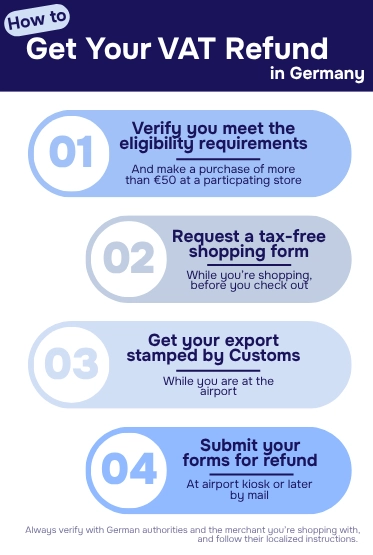
Getting a refund is a relatively simple process, but there are a few things you need to do at the store you’re shopping at, at customs, and at the refund point/when you get home. There isn’t just one way to get a VAT refund, since there are third parties that can be involved.
Unfortunately, if you’ve already gotten home and it dawned on you that you could get a VAT refund, it’s already too late, because you have to start the process while in store.
While you’re in the store
Verify whether or not the store offers VAT refunds. Not all of them do, nor do they have to. Stores that do will sometimes have a “Tax Free Shopping” sticker on their window, or a sign up in their shop somewhere. It’s worth asking the clerk if they offer it.
You need to request a German tax-free form in the store you’re shopping at. Make sure you ask for this before you check out. It’s called an Ausfuhrbescheinigung in German. Remember to keep all of the eligibility requirements described above in mind, too. If a store offers VAT refunds and partners with a third-party refund operator, you may receive a form that is from the third party, so fees may apply. Make sure the merchant fills it out at the store. If you want, you can also print the form out ahead of time and bring it with you to the store.
When you get your receipt, you’ll receive the tax-free form (remember to ask before you buy). Make sure to keep both, as you will need them later.
When you’re at the airport
| Important note: According to the German Missions in the US, your flight must leave the European Union from Germany and be non-stop. If you have a connecting flight, we recommend checking with German Customs and/or your tax-free refund provider to see where and how your documents need to be presented in order to qualify. |
If your goods are in your checked bag
If you’ve packed the eligible items in your checked bag, make sure you tell the airline check-in agent that you need an export and buyer’s certificate to get a VAT refund for purchases in your checked luggage. Do this before they take your bag away and put it on the conveyor belt. They’ll direct you where to go.
If your goods are in your carry-on luggage
You can still let the airline agent know that you have items you’d like to get a VAT refund for. They’ll also direct you where to go. Keep in mind that there are still the regular regulations, one of them being liquid limits.
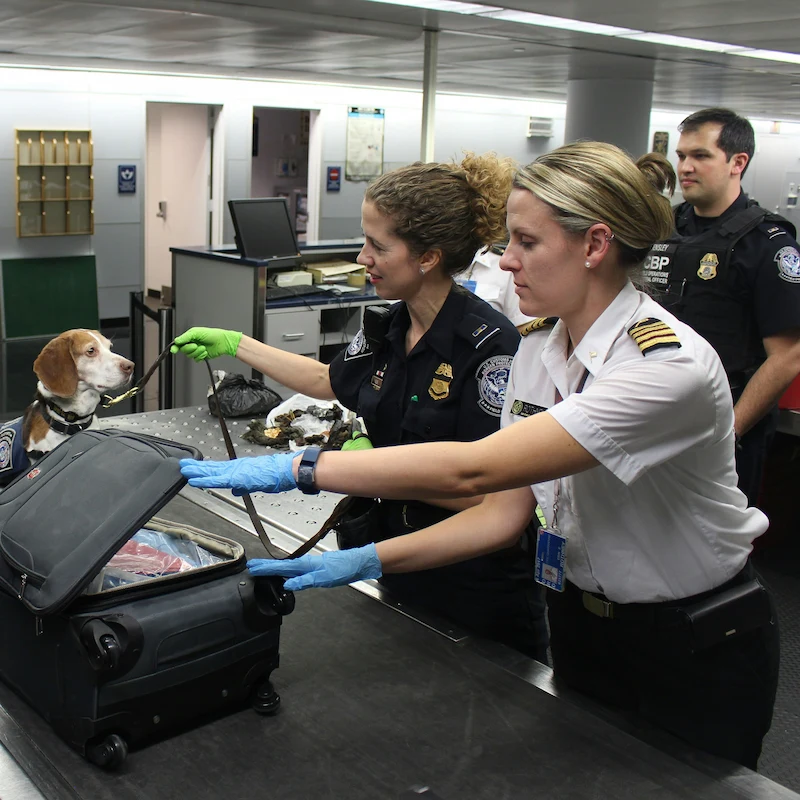
The Customs officer will review your item(s), receipt(s), and form(s), and confirm the export by stamping it. This has to happen in order for your purchases to be eligible.
After Customs has declared the export
Next, you need to get the actual refund, and there are a couple of ways that you can do this. You can do this at the airport itself, or once you get back home. If you choose to get your refund at the airport, you’ll be working with a third-party service, which means there will be a fee – but it also means you can get your refund immediately.
The alternative is waiting until you’re back home and mailing the export and buyer confirmation to the merchant you purchased from. Once received and processed, they’ll be able to refund you.
Processing times vary. At the airport, it depends on how long the line is and how busy the airport is. If you mail it, it depends on where you live and where the merchant is located, because you’ll need to factor in shipping time (and cost, too, particularly if you have several forms). This way can take weeks. Depending on partnering refund service providers, there may be online options available, but, again, watch out for fees.
VAT refunds at Germany’s major airports
Frankfurt Airport (FRA), Munich Airport (MUC), and Berlin Brandenburg (BER) all have clear instructions on how to get your VAT refund processed at their airports.
Before you go, make sure you have all of the documents you need (the form, receipt, and the unused goods themselves), and arrive at the airport with plenty of time. Most airports recommend 3 hours for international flights.
Frankfurt Airport’s process
If your goods are in your checked baggage, let the agent know when you’re checking in. They’ll put a special label on it so it can be returned to you at customs, so you can present the eligible items.
If your items are in your carry-on, you’ll already have them with you!
When departing from Terminal 1 at Frankfurt
| Cost of Goods | Where to Get Your Certificate |
|---|---|
| Less than €5000 total, gross | Departure Hall C Customs Office |
| More than €5000 total, gross | Transit Area B Customs Office |
Once you have the form, go to the Customs Office located near your departure gate to get it stamped. Make sure you have your forms, receipts, items, and ID ready to show. After this, you can go to one of the refund counters and present all of your papers, including the customs stamped one, and get your refund. Or, you can take all of the information home with you and mail it in, depending on which process you’d like to go with. Frankfurt has refund counters available after customs.
The refund counters are not open 24/7, but they do have rather long open hours, seven days a week.
Munich Airport’s process
At Munich, the process is similar to that at Frankfurt. You need to complete the export paperwork and present it, your receipt(s), item(s), passport, and plane ticket to the Customs officer at the Customs Office. Once they’ve validated the export with a stamp, you can go to the counter to get your refund, or choose to mail in your documents later. The refund operator at Munich Airport is Global Blue. Global Blue is not open 24 hours a day, but they are open all day, every day.
Berlin Brandenburg Airport’s process
The process is similar to that of Frankfurt and Munich (see above). For checked baggage, you need to go to the baggage counter and get a label for your bag(s). Then, you need to take your bag(s) to the Customs Counter at Check-In Island 7. In the Gallery in the Main Hall is the Customs Office, where you will need to present your paperwork and goods. There are Global Blue refund counters at the airport where you can get your refund in cash, or you can mail in your documentation later.

What to carry on you
- Your receipts/invoices
- The physical goods that you've purchased
- The tax-free shopping form, filled out
- Your passport/ID
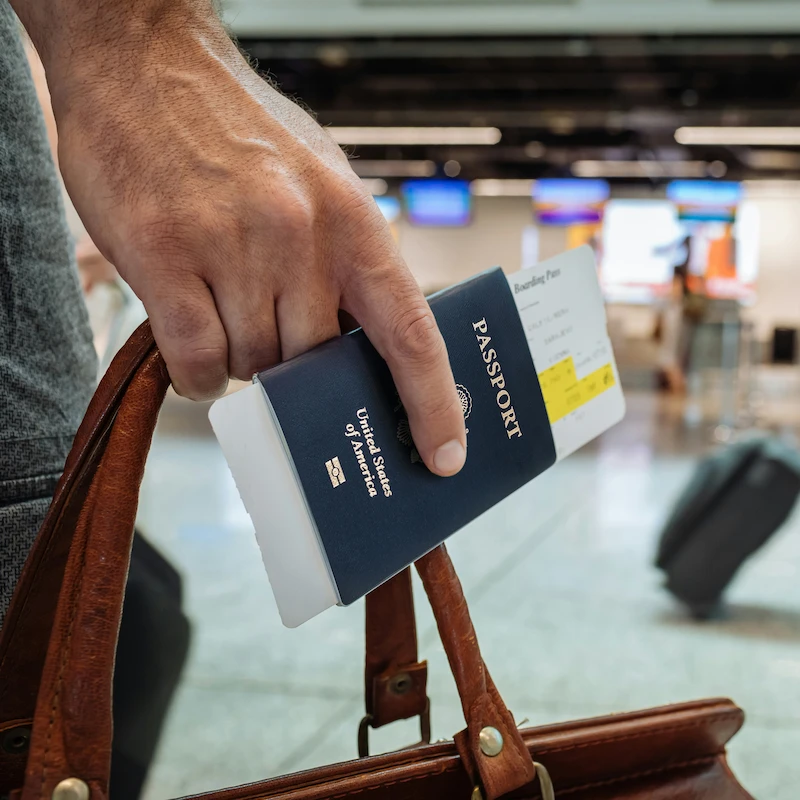
- Your boarding pass/airplane tickets
What to keep in mind for your German VAT refund
This guide contains a lot of information. While all of it is relevant and important, there are a few things that you need to keep in mind.
You need to spend more than 50 euros
First, you have to hit that 50 euro threshold – in one store, on one receipt. This means you need to spend at least 50.01 euros in order for your purchase to qualify.
Think about which card you use
If you really want to maximize your savings, choosing which debit or credit card you use ahead of time can help. Many cards have foreign transaction fees. You can learn more about this in our Debit and Credit Card Guide.
Keep your items accessible
Even if you decide to put your qualifying purchases in your checked bag, don’t put them all the way down at the bottom. This way, when Customs personnel ask to see them, you don’t have to tear all of your clothes out to find them. You never know how busy the airport is going to be, either, so sometimes every minute of extra time matters when the clock is running out at the gate.
If you’re shopping luxury
Some luxury stores may have in-house refund counters or services. If you’re planning to spend on luxury goods, it is worth asking ahead of time.
Frequently asked questions
 Sources & references
- Internal Expertise & Review
- For nearly two decades, we've been helping travelers feel more confident for their journeys to Germany and beyond. Our team is a combination of Schengen visa insurance experts and European travel advisors. Together, we create guides to help you better understand your options and rights while in Germany.
- Official VAT Refund Information:
- Tax-Free Shopping : Tax free shopping procedures and options from the official German Customs Authority
- VAT Refund How-To : Guide to getting a VAT refund in Germany from the German Federal Ministry of Finance
- Info for US Citizens : Information on VAT refunds from the German Missions in the US
- Germany VAT Form : Official downloadable PDF of the Germany VAT form
- Federal Central Tax Office : VAT information for German businesses
- German Airports:
- VAT Refunds at Frankfurt : Information about getting your VAT refund at the Frankfurt Airport
- VAT Refunds at Munich : Details on getting a VAT refund at the Munich Airport
- VAT Refunds at Berlin : Getting a VAT refund at the Berlin Airport
- Written by:
- Sarah Pardi - Staff Travel Advisor
- Fact-check and reviewed by:
- Clément Goubon
- Last updated:
- October 23, 2026
Learn more about our editorial standards and review process in our Editorial Policy.
Related posts


Upcoming travels ? Get Insured !
Find the right insurance for your trip by using our powerful comparison tool!
Sarah Pardi - October 23, 2026