
Plug Types in Austria: What Travelers Need in 2026
Sarah Pardi - May 20, 2026
Home > Travel Guide > Travel Safety & Health > Plug Types in Austria: What Travelers Need in 2026
Share this post
If you're traveling to Austria from the US or the UK, you're going to need to make sure you have an adapter in order to plug in and charge your phone, or use your other tools like blow dryers and hair curlers.
Different countries use different levels of wattage and have different-shaped sockets and plugs. From vertical lines to perfect circles, they're not universal.
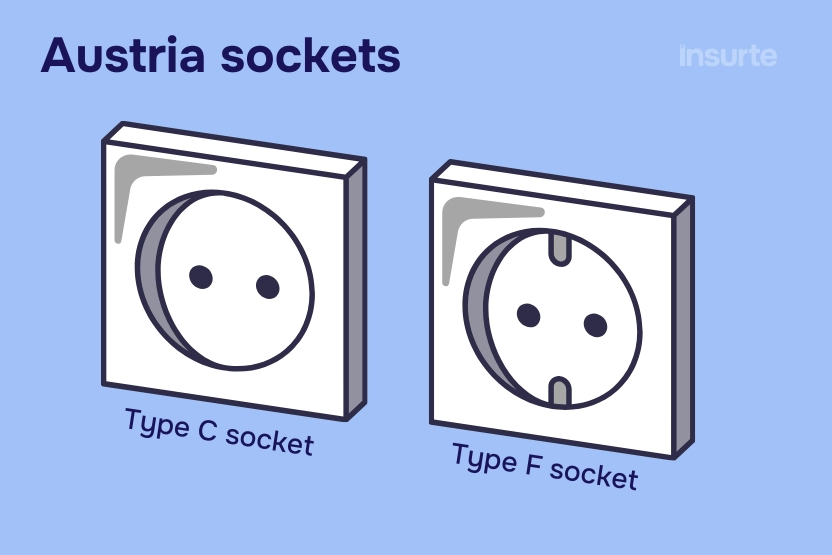
Austria uses Type C and Type F sockets and plugs, which are different from those in the United States, Canada, and the UK.
From your airline tickets and your travel insurance, travel adapters are one more thing to add to the international travel checklist.
Which adapter is needed for Austria
Whether it's Vienna, Salzburg, or anywhere else in Austria, you will need an adapter to plug in your electronics if you're traveling from the US, Canada, or the UK.
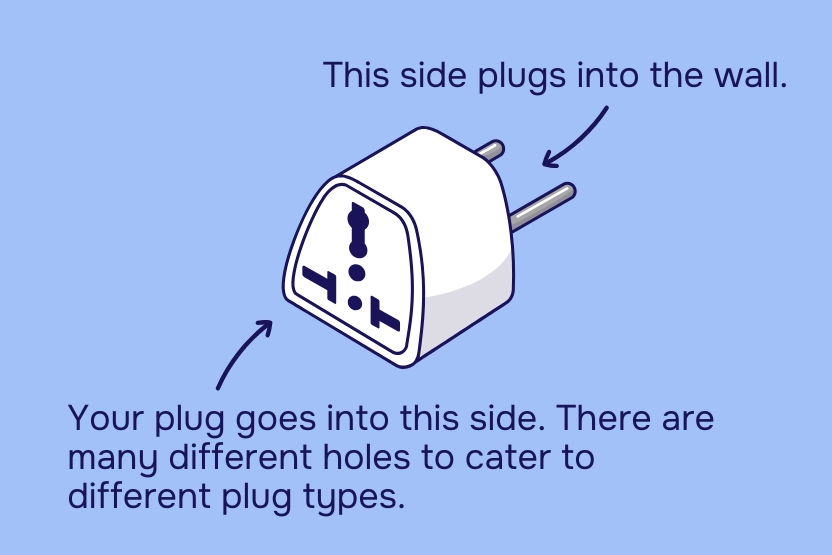
Typically, adapters have two sides. The first side has several input holes, allowing it to work for different types of plugs from around the world.
The other side has an actual plug in the shape you need. For Austria, as said above, that's the Type C prong.
The adapter works by inserting your plug into the front side, and then plugging the "plug side" into the wall. The adapter temporarily "converts" your plug to a different prong type.
About Austria's Type C plug
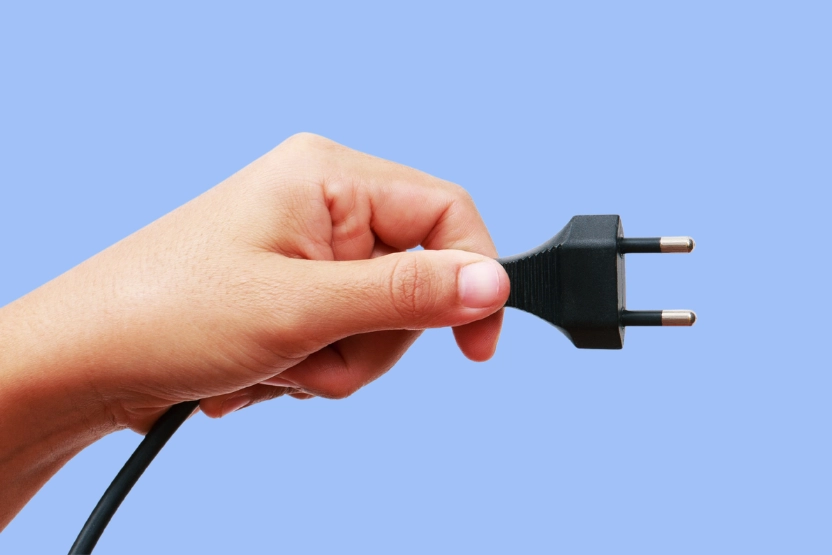
The Type C plug has two thin, cylindrical prongs. Unlike in the UK, US, and Canada, there aren't any "vertical" shaped plugs. Instead, they're perfect circles.
The Type F plug can also be used. Prong-wise, they're virtually the same. However, Type F plugs usually have a larger base to support a grounding clip.
If you're from the States, sometimes your plugs have two prongs. Sometimes they have three. That optional third prong is a "grounding prong". Grounding prongs aren't necessary for functionality. Instead, they are an additional safety feature to help protect against things like electrical shocks and fires.
Regardless, both are entirely safe to use.
Off to Austria?
Get the travel insurance you need, 100% online.
Travel adapters for Austria are widely available
Type C and F travel adapters are easy to find. Most of Europe uses the Type C/F plug. This means that if you've been to France, Spain, or several other EU countries before, and you still have an adapter buried in a drawer somewhere, it will work in Austria.
If you don't have one, they're available in many places, like:
- Department stores like Target or Walmart in the States.
- Electronic stores (Best Buy, etc.).
- Online retailers (Amazon, etc.).
- At airports.
Many airports sell travel adapters, but keep in mind that the prices will likely be higher at airports or convenience stores than they will be at department stores or online.
Still, it's nice to know that if you forgot to get one, or you're reading this at the airport last minute, you're not out of luck.
Many tourist areas in major European cities (like Vienna) will have travel adapters available, too.
Do you need an electrical converter?
Just as countries have different sockets, they also can have different voltage levels.
For all intents and purposes, volts are what "push" electricity through the cables and into your electronics. Higher levels of voltage mean more electricity is being pushed through. This is a simplification, but it gives you an idea about why it's important.
The EU has a higher voltage than the States and Canada. The EU and the UK are pretty much the same.
If you're traveling to Austria from the US or Canada, you will want to consider getting a travel converter if you're planning to use small devices/appliances like blow dryers or hair straighteners.
Electrical products are designed to function with the voltage in the country where they're being sold. Curling irons, for example, purchased in the US run on a lower level of watts. If you plug one in in Austria, you'll find that the entire iron (including the plug and cord sometimes) gets really hot.
Not only is it really hot, it's also risky. Using a tool designed to work with different voltages can cause sparks, shorting out, and even pose a fire risk.
You don't always need a converter
Many electronics are designed to be dual-voltage. This means that they work across multiple voltages. For instance, most laptops and mobile devices are dual-voltage, which means they're safe to use at lower voltages and higher ones.
Make sure you look up the make and model of your devices before you travel to make sure they're dual-voltage. If they aren't, you should get a converter.
FAQs
Heading to Austria? You might also like...
Do you need ETIAS for Austria?
Related posts





Upcoming travels ? Get Insured !
Find the right insurance for your trip by using our powerful comparison tool!
Sarah Pardi - October 27, 2026