

Travel medical insurance is one of the most important things you can pre-plan before you actually set out on your trip. It ensures that you're covered in case of unexpected medical emergencies while overseas.
In some cases, it's even mandatory, as is the case with Schengen travel insurance for visa applications.
Whether you're heading abroad for vacation, a work trip, or just to visit family or friends, travel medical insurance is an important part of the puzzle - and it's just as important that you understand what it is, too.
What is travel medical insurance?
Travel medical insurance is a specialized insurance policy designed to cover emergency medical expenses while you are outside your home country.
This kind of coverage is important because, typically, domestic health insurance doesn't work abroad. This leaves you financially vulnerable if you end up getting in an accident or becoming ill while you're abroad.
Travel medical insurance ensures that you can receive the right emergency medical care and avoid large medical bills that could leave quite a dent in your wallet.
Travel medical insurance can cover a range of guarantees, such as:
- Emergency medical costs.
- Hospital stays.
- Medical evacuations.
- Repatriation.
On the other hand, there are a few things that travel medical insurance does not cover, such as:
- Preventative care (annual exams, physicals, etc.).
- Routine care (teeth cleanings, eye exams, etc.).
- Daily/weekly/monthly treatments (dialysis, etc.).
- Pre-existing conditions.
- Any regular/expected treatments.
Why you need travel medical insurance
Accidents and illnesses can happen when you least expect them. Unfortunately, trips and vacations aren't immune.
Without the right policy, you could find yourself in a situation where you cannot afford medical care... even if you really need it.
One of the reasons that travel medical insurance is recommended so often is that healthcare systems vary significantly from country to country. Not only do the systems differ, but costs do too. The price you'd expect to pay in your home country could be significantly different than the price you'd see in another.
In some cases, hospitals or doctors could need cash up front before treating you.
On top of that, some countries, including those in the Schengen area, require proof of travel medical insurance as part of the visa application process. When required for visa applications, not just any policy will do. The policy has to meet specific requirements. In the case of Schengen visas, those are the Schengen visa requirements.
Moreover, some countries, including those in the Schengen area in Europe, require proof of travel medical insurance as part of the visa process. This ensures that visitors have the means to cover emergencies during their stay.
What to pay attention to
Coverage limits
Different policies have different levels of coverage. If you're worried about high emergency medical costs or medical evacuation, you'll want to choose a plan with higher coverage limits.
For Schengen visa applications, your policy needs to cover at least 30,000 euros in emergency medical costs.
Comprehensive coverage
It's never a bad idea to look at policies that offer comprehensive coverage, so more than just your lowest medical coverage. It's possible to get travel medical insurance policies at both ends of the spectrum, with less coverage or with more.
Some travel insurance policies include coverage for things like lost passports, COVID-19, or lost luggage. It all depends on the policy, but these types of benefits can be a good idea if you're going abroad.
Emergency medical evacuation
In some places or countries, it can be hard to find specific kinds of treatment. If you have a medical emergency that requires advanced technologies or specialities, it may be necessary to medically evacuate you to the nearest suitable hospital, or even back home.
In some cases, emergency medical evacuation is mandatory. This is the case for Schengen visa applicants. This means that if you are applying for a Schengen visa, you need to make sure that your policy includes coverage for medical evacuation.
Repatriation of remains
It's a scenario that no one likes to think about. In the unfortunate event of a death overseas, many travel insurance policies cover the cost of transporting remains back to your home country.
Like medical evacuation, repatriation is mandatory for Schengen visa applicants.
Pre-existing conditions
In the vast majority of cases, travel medical insurance does not cover pre-existing conditions. Make sure you read about your policy's exclusions, like pre-existing conditions. Exclusions can be found in the terms and conditions.
Depending on your health needs, it could make sense to take out an international health insurance policy.
Trip duration
Make sure that your travel insurance can cover you for the entire duration of your trip. In some cases, such as for Schengen visa applications, that's mandatory.
Types of travel medical insurance
Single-trip insurance
Single-trip insurance covers you for one trip. Each time you take a new trip, you'll need to take out a new single-trip insurance policy.
Single-trip travel medical insurance policies are a great idea for infrequent travelers. Each time you plan a trip, you can choose a new policy that suits your needs.
Multi-trip insurance
If you're a frequent traveler, on the other hand, a multi-trip plan could be a better alternative for you. Multi-trip policies cover you for multiple trips within a specific period (noted by your policy).
Multi-trip insurance ensures you’re covered for the entire period of validity, no matter when or where you go (as long as it’s in the countries covered by your specific policy. Keep in mind that your policy may have a maximum duration per trip).
Schengen visa insurance
If you're traveling to the Schengen area and need to apply for a visa, you’ll need Schengen visa travel medical insurance.
This insurance must meet specific requirements, such as coverage of at least €30,000 for medical expenses, including emergency medical evacuation and repatriation. It must also be valid in every country in the Schengen area and for the entire duration of your stay.
Annual travel insurance
Another excellent option for frequent travelers is annual travel insurance. Annual travel insurance comes at a yearly price and covers you for the entire year (just make sure to check whether or not your policy has maximum trip durations, as well as which countries are covered).
You will also have the choice to have your policy renewed each year automatically (until you choose to terminate it).
This option works well for frequent travelers who plan to travel continuously for the next year or two, or more. It gives you the convenience of choosing a policy once, where you can just set it and forget it.
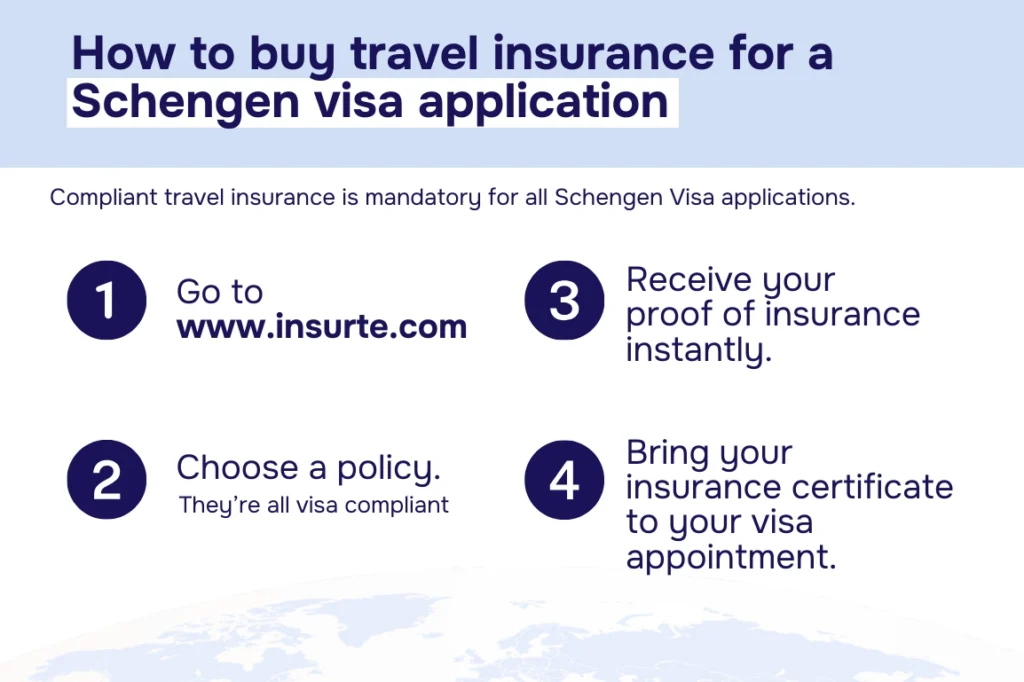
How to buy Schengen travel medical insurance
You can get Schengen travel insurance online through Insurte.
It only takes a few minutes, and all of their policies are compliant.
- Fill out a form with a few details about your trip.
- Receive a quote instantly and compare policies.
- Purchase the policy that’s best for you.
- Receive your digital insurance certificate by email immediately!
With Insurte, in the event of visa rejection, you can request a full refund.

Travel medical insurance costs
The cost of travel medical insurance depends on several factors, including:
- The length of the trip.
- Your destination.
- Coverage limits.
- Deductibles or no-deductibles (also known as excess or no-excess).
- How many travelers need coverage (is it just you or a spouse too?).
- How many days you need to be covered.
Typically, the cost can range from a few dollars per day for basic coverage to higher premiums for comprehensive policies covering a wider range of potential travel risks.
 Sources & references
- Internal Expertise & Review
- Insurte has 15+ years of experience in the travel insurance space, specializing in Schengen visa insurance. Our team of experts and passionate travelers is dedicated to sharing accurate, relevant information about travel insurance.
- Your Travel Insurance Experts
- About Insurte : About Insurte's promises and offering
- Written by:
- Sarah Pardi - Staff Travel Advisor
- Fact-check and reviewed by:
- Clément Goubon
- Last updated:
- March 17, 2026
Learn more about our editorial standards and review process in our Editorial Policy.