
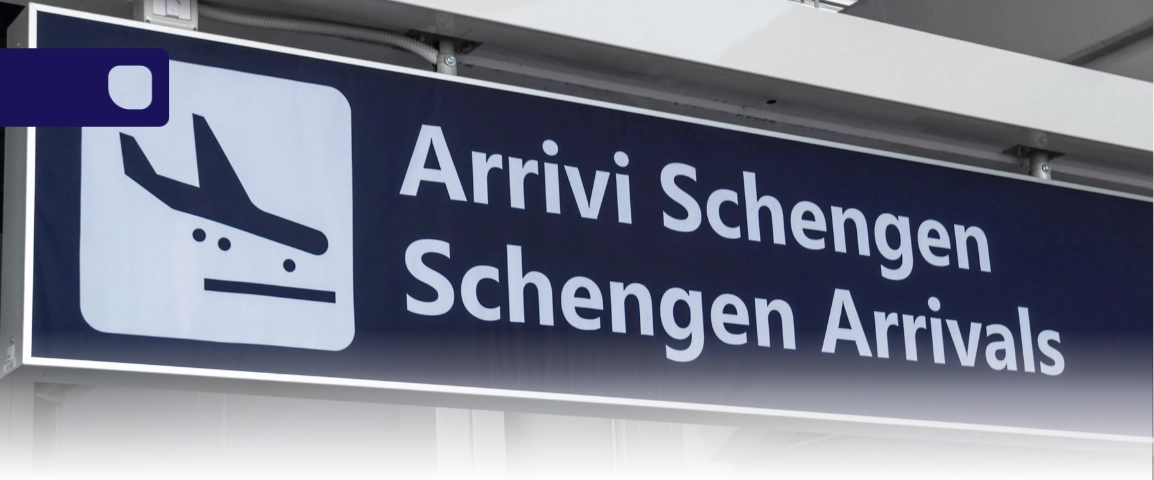
The Entry/Exit System (EES for short) is now in effect at the external borders of 29 European countries, including the most popular destinations for international travelers. It digitally records every single entry and exit of non-EU nationals visiting for short stays. The system began rolling out on October 12th 2025, and then became fully operational on April 10th, 2026. EES isn’t something you have to prepare for ahead of time; registration takes place at the border. It isn’t a visa or application you need to fill out before you get to the airport.
Quick information: If you are a non-EU traveler (UK, US, Canadian, Australian citizen, etc.) visiting the Schengen area for short stays, you will need to be registered in the EES. This includes travelers on Schengen visas and travelers who are visiting on just their passports. If you’re an EU, EEA, or Swiss citizen, or hold a qualifying residence permit/long-stay visa, you are exempt. This system hasn’t changed the 90-days in 180 rule. It tracks it.
Note: EES doesn't impact Schengen visa requirements (such as Schengen travel insurance). It does apply to Schengen visa holders, however.
Before you go to Europe...
Make sure you have the right travel insurance for your journey.
Latest News & Updates on EES (Entry/Exit System)
The 6-month transitional roll-out is completed, and EES becomes fully operational across Schengen borders. While fully up and running, some borders may still experience some delays and/or gaps in operation (source).
The new Entry/Exit System launches across the Schengen zone. The 6-month transitional period begins, where some borders may use EES while others still work towards implementation (source).
The European Union announced a revised timeline for both the Entry/Exit System and ETIAS. EES was pushed back to October 2025, while ETIAS to Q4 of 2026. In this publication, a 6-month transitional roll-out for EES was also announced (source).
eu-LISA announces that the EES roadmap has been updated and that the change has been approved by the EU Council, after an EU Justice and Home Affairs Council session on October 19th (source).
eu-LISA reports that the May 2023 EES launch date is no longer feasible, pushing the date to the end of 2023 (source).
The European Parliament publishes that EES has been pushed back to May 2023 (source).
+
The Entry-Exit System (EES) is formally adopted by the European Union (Regulation (EU) 2017/2226) with an expected 2022 launch (source).
| EES Europe 2026 | |
|---|---|
| System Status | Live and fully operational since April 10, 2026 |
| Where | The external borders of 29 European countries (Schengen) |
| Who | Most non-EU nationals entering for short stays (w/ or w/out a visa) |
| Cost | No cost to travelers |
| What Changes | Digital entry and exit records replace passport stamps |
| ETIAS | A separate travel authorization that has not yet gone into effect |
What is EES?
EES stands for the Entry/Exit System. It’s a border system in Europe that has replaced physical passport stamping when entering and exiting. The digital system records when travelers enter or leave a participating country, as well as if their entry is refused. It helps calculate the duration of any given traveler’s short stay, but it itself doesn’t grant permission as to whether someone can enter. Border officers still make this decision.
You’ll encounter EES when you cross external borders of the participating area. This means that a trip from France to Italy, for example, doesn’t require you to go through EES, since they share internal borders (of the Schengen area). A trip from the US to France, on the other hand? You’ll need to go through the EES. The specific border procedure can vary from airport to airport, station, or port, so make sure you follow local instructions and official signage.

Do I need to register in the EES?
Your nationality and immigration status dictate whether or not you will need to register. The table below covers common situations, but check the official EU exemptions page for the entire list.
| Traveler | EES Registration? | Why |
|---|---|---|
| UK, US, Canadian or Australian visitor for short stays (fewer than 90 days) | Generally yes | These are non-EU nationals visiting for a short stay, without a visa |
| Traveler with a short-stay Schengen visa | Generally yes | Long-stay Schengen visa holders are typically exempt |
| EU, EEA, or Swiss citizens | No | EES is to track non-EU nationals |
| Dual national traveling on an EU, EEA or Swiss passport | No | Present the passport establishing your status; follow official guidance |
| Holder of a valid residence permit or long-stay visa | Generally no | Listed as EES exemptions; carry evidence of your status |
| Non-EU family member with a qualifying residence card | May be exempt | The exemption depends on the document and the applicable free-movement rules |
| Non-EU child under 12 on a short visit | Yes, if otherwise in scope | A facial image may be recorded, but fingerprints are not scanned below age 12 |
If you own a vacation home in Europe, it doesn’t make you exempt, by default. It depends mostly on your passport, immigration status, and how long you intend to stay. After all, EES exists to track how long people have stayed in the zone (for short stays) to help ensure that people aren’t overstaying their visa or visa-free allowances. Check the official rules before you head to the airport.
Which European countries use the EES?
There are 29 countries with this border system, which are Austria, Belgium, Bulgaria, Croatia, the Czech Republic, Denmark, Estonia, Finland, France, Germany, Greece, Hungary, Iceland, Italy, Latvia, Liechtenstein, Lithuania, Luxembourg, Malta, the Netherlands, Norway, Poland, Portugal, Romania, Slovakia, Slovenia, Spain, Sweden, and Switzerland. Ireland and Cyprus do not use EES, even though they’re both members of the European Union. The UK doesn’t have EES either.
Don't Forget...
make sure you have travel insurance before you head abroad
| Country | Do They Have EES? | Details |
|---|---|---|
| The UK (England, Scotland, Wales, Northern Ireland) | No | The UK isn't a member of the Schengen Area |
| Ireland | No | Member of the EU, but not the Schengen Area |
| Cyprus | No | Member of the EU, but not the Schengen Area |
| Paris, Rome, Amsterdam, and Barcelona | Yes | These cities are in Schengen-member countries |
Where will the EES check happen on my trip?
You will pass through the EES where you first enter the Schengen area and where you leave.
If you’re traveling from New York to Paris to Rome, you will likely pass through EES in Paris, when you cross the external border. You won’t pass through between Paris and Rome, since they are internal borders.
If you’re traveling from Rome to Paris to New York, your exit will be recorded in Paris, where you leave the Schengen area.
If you have a layover and stay in the international transit area, you won’t need to register for EES until you cross into the Schengen area. Source: official app FAQ.
There isn’t a universal wait time estimate, but you can check with your airline, airport, or other transportation carrier to see what they recommend. You may need a little extra time if it’s your first time going through the new system, since registration is required.
What happens at the border?
The first time you enter the Schengen area (since EES was implemented), you will register. Depending on where you are, either a border officer will register you, or you will register yourself through a self-service kiosk. You will have a photograph taken of your face, as well as your fingerprints scanned. The place, date, and time of your entry (and later, exit) are recorded. On future trips, passing through the border may be faster, as your info will have already been registered. Still, your data may need to be collected again.
Using a kiosk, the Travel to Europe app, or registering your information in EES doesn’t guarantee you’re allowed to enter the Schengen country.
Do I need an EES application or to pay an EES fee?
No, registering for EES is part of the border check; it isn’t a travel authorization. EES tracks your entrance and exit; it doesn’t allow you to enter or exit. It’s a tracking system, not an authorization system. You will still need any visa or other documentation (such as a passport) required for your journey. Be wary of websites offering to sell you an “EES visa” or tell you that there is a mandatory EES application and fee – there isn’t. Source: GOV.UK Travel guidance
There is a mobile app, but it’s optional. The Travel to Europe app doesn’t replace the EES; instead, it supports it. Where in use, travelers with biometric passports can pre-register some information within 72 hours of their trip. Currently, Sweden and Portugal are in the app, with different functions for each. Check the official app page for the countries and functions available for your travel plans. We also have a practical guide to the app.
Does EES change the 90/180-day rule?
No. The only thing EES changes is how the European Union tracks your entries and exits, not the actual entry and exit rules. For visa-free travelers (such as US citizens), the maximum is still the same. You can stay up to 90 days in any rolling 180-day period across the entire zone. If you have a short-stay visa, it might allow you less time, but 90 days is still the maximum.
The EU has an official online tool to check remaining authorized stay. It can be helpful to use it alongside your travel plans, especially if you’re planning a lengthier trip or you travel to a Schengen country several times a year.
What information does EES store, and for how long?
The EES records travel-document details, dates, times, and places of your entry and exit, facial images, and fingerprints. It also stores info about any entry refusals. How long the information is stored depends on the specific record type. All information is stored for at least three years.
| Record | How long it's kept on file |
|---|---|
| Entry, exit, or refusal record | 3 years from creation |
| Personal file after last exit or refusal | 3 years and 1 day |
| File with no recorded exit | 5 years from the expiration of the authorized stay |
Keep in mind that specific rules apply to some family members of EU, EEA, or Swiss citizens. Also, travelers can request their EES data be removed, corrected, or deleted if they believe it to be inaccurate. The EU has a Data and Rights Guide that explains the process.
EES vs ETIAS: what is the difference?
These are two separate things. EES is a “tracking” system that is already in operation. ETIAS is a pre-travel authorization that will be required for visa-exempt travelers from dozens of countries, including the US, Canada, and the UK. As of October 2026, ETIAS is not accepting applications. The EU hasn’t announced a start date, but has said that they will release a date several months prior to launch. For a closer comparison, you can read Insurte's ETIAS guide.
| EES | ETIAS | |
|---|---|---|
| Purpose | Records border crossings of non-EU/non resident nationals | Authorizes eligible visa-free travel before departure |
| Status October 2026 | Live and in effect | Not yet operational |
| Who it mainly affects | Short-stay non-EU travelers | Non-EU/EEA visa-exempt travelers without a visa |
| When it applies | At the external border (Schengen countries) | You apply before traveling (once launched) |
| Do you have to apply? | No | Yes, once launched |
What if an EES entry or exit is missing or incorrect?
Keep your travel-related documents, such as your boarding passes or ticket confirmations, if you notice a discrepancy. Ask the competent or immigration authority of the participating country to check and, where appropriate, correct the record. The EU gives travelers the right to request access to your data and rectification of information that is confirmed inaccurate. If you notice a missing exit on their official tool, don’t ignore it.
Before you travel: EES Checklist
- Check whether or not your nationality and immigration status require you to register for EES.
- Check where your first external border crossing will happen, and allow a little extra time for your first EES registration.
- Check to see whether the Travel to Europe official app is available for your journey (it’s only available for select member countries, and use is optional).
- If you travel to the Schengen area a lot, check how many days you have left in your 90/180-day allowance.
- Use official EU or government websites for updates on EES. EES does not require a paid application or advance prep work.
If you’re applying for a Schengen short-stay visa: EES does not replace your visa requirements. Make sure you check the consulate’s travel medical insurance rules and review Insurte’s Schengen insurance guides. Travel insurance isn’t an EES requirement, and it isn’t mandatory for every visitor to Europe, but it’s still mandatory for Schengen visa applicants.
Frequently asked questions
 Sources & references
- Internal Expertise & Review
- With more than 15 years of experience, our team of experts is dedicated to providing relevant European travel information that is accurate and up-to-date. We're committed to sharing resources and guides to help travelers feel more confident all over the globe.
- Information on The Entry/Exit System (EES)
- Information on EES : The Entry/Exit System official website from the European Union
- European Law:
- Regulation (EU) 2017/2226 : Regulation establishing the Entry/Exit System
- Regulation (EU) 2025/1534 : Regulation amending the launch of EES
- Press Releases & Updates
- 11 July 2022 : Answer about EES given by Ms Johansson on behalf of the European Commission
- 31 January 2023 : eu-LISA Management Board, delays announced
- 19 October 2023 : Justice and Home Affairs Council, EES pushed back
- 6 March 2025 : Revised timeline for EES launch
- 10 October 2025 : The EU's Entry/Exit System progressively starts operations on 12 October 2025
- 10 April 2026 : EES becomes fully operational
- 27 July 2026 : The EU reminds travelers who is EES-exempt
- Entry/Exit System News:
- ACI Distress : ACI asking for relief from EES-caused delays and issues
- EDPS Concerns : Concerns and questions raised by EDPS in 2013, in response to the Smart Borders Package
- Written by:
- Sarah Pardi - Staff Travel Advisor
- Fact-check and reviewed by:
- Clément Goubon
- Last updated:
- October 20, 2026
Learn more about our editorial standards and review process in our Editorial Policy.