

Short-stay Schengen visas (Type C) have several requirements to be aware of. You need a filled-out and signed application form, a valid passport, a recent photo, travel medical insurance, your flight/travel bookings, accommodation details, and evidence that you can afford to pay for your intended trip. In some cases, you may be asked to provide additional documents like a cover letter that says why you’re traveling, an employment letter, and more.
This guide covers the current requirements for Type C Schengen visas, including for tourism, business trips, and/or to visit family and friends abroad. What decides whether or not you need to get a Type C Schengen visa is your nationality and destination.
Yes, It's Required
Compliant insurance is mandatory for Schengen visas. Get your certificate now
Schengen visa requirements checklist
This table provides an overview of the basic requirements. It’s a good idea to start here, and then check the following sections that are relevant to your specific situation. If you’re a family applying, every traveler, including children, needs to have their own application, regardless of age.
| Document or Requirement | What to Prepare or Check |
|---|---|
| Application form | Follow the application process for your destination, fill out the form & sign/date it where required |
| Passport | Check the issue date, expiration date & that there are at least two blank pages. It must have a minimum of 3 months of remaining validity beyond your intended trip |
| Visa photograph | Get a recent visa photo in the format & quantity requested locally (35 x 45 mm) |
| Travel medical insurance | Obtain an insurance certificate showing the insured person, coverage, territory & travel dates. Insurance must meet specific requirements |
| Accommodation bookings | Provide bookings or the host documents required for the places you will stay. Required documents can vary depending on travel purpose and destination |
| Financial means | Gather bank statements, income evidence, or sponsorship documents depending on your situation & destination |
| Appointment and fees | Check appointment locations & be ready to submit fingerprints & pay the application and any applicable service fees |
Before you start gathering all of the documents, you need to find out which visa application center or consulate is responsible for your destination. Once you do, they will provide you with an official checklist. While the checklist above is helpful (and accurate per the Visa Code), the checklist you receive from the consulate will have specific details, including any additional information or particular formatting, so always go by that one over any others you find online.
Who needs a Schengen visa?
Whether or not you need one depends primarily on the passport that you’re traveling with, not the country that you legally reside in. Ordinary passport holders from countries including China, India, and South Africa need a short-stay visa before traveling to any Schengen country (subject to any applicable exemptions).
On the other hand, some nationalities do not need a Schengen visa for short trips. US citizens, for instance, can visit Schengen countries for tourism, business trips, and to visit friends and family for up to 90 days (in a 180-day period) without applying for a visa. Living in the US doesn’t automatically give you that permission. It depends on your passport, not your physical address. If you hold a foreign passport but live in the States, you may still need a visa. A Green Card or US visa doesn’t influence whether or not you need one.
No matter where you’re traveling from, go off of your passport nationality, not your legal residence.
Different criteria can apply to travelers who have Schengen residence permits and/or family members who are EU or EEA citizens. Long stays (more than 90 days), relocation, and employment can (and usually do) require a traveler to apply for a national visa, which is not the same as a Type C Schengen visa and has different requirements. Refer to the EU visa policy guidance before you get started so you know the best visa to apply for.
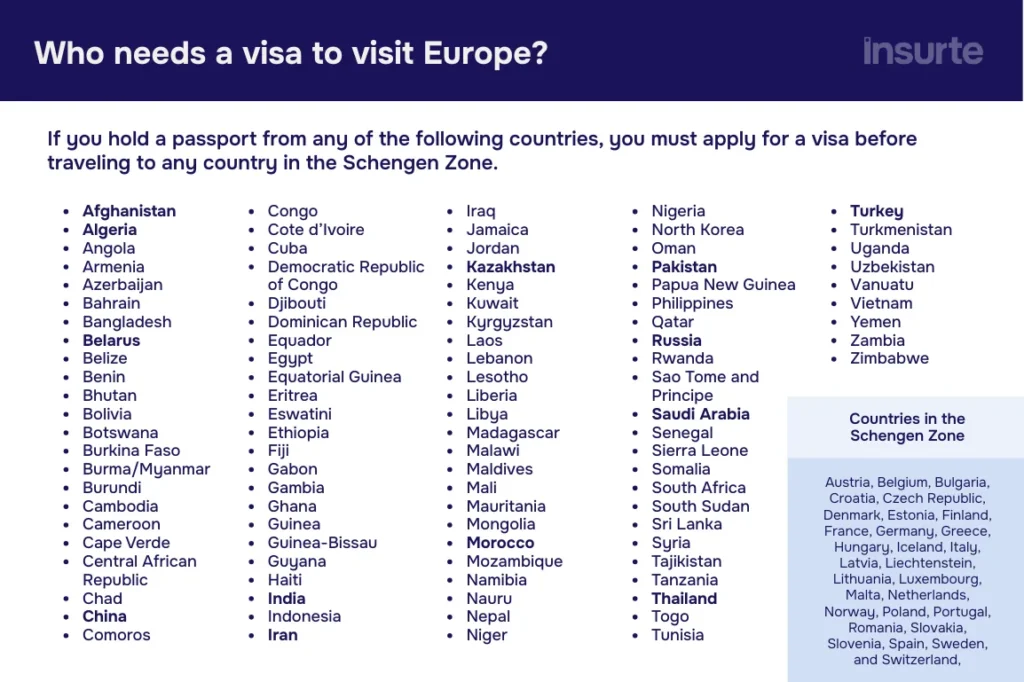
Schengen countries visa requirements
The Schengen Area has 29 current members, which are: Austria, Belgium, Bulgaria, Croatia, Czechia, Denmark, Estonia, Finland, France, Germany, Greece, Hungary, Iceland, Italy, Latvia, Liechtenstein, Lithuania, Luxembourg, Malta, the Netherlands, Norway, Poland, Portugal, Romania, Slovakia, Slovenia, Spain, Sweden and Switzerland.
Uniform Schengen visas typically allow their holder to travel in the area, to any of the listed members, all under the same visa (subject to its territorial validity, which, if there are specifications, will be listed on your actual visa). How much and how long you can travel depends on your visa’s entry allowance and expiration date.
The Schengen Area has a shared short-stay visa process, and the general requirements are the same, but still, not every checklist for every Schengen destination is exactly the same. Financial thresholds, host documents (when staying with a host), translations, formats, and other details can vary.
Which country to apply to
If you’re only traveling to one country, that’s easy. Apply for a Schengen visa for that country. If you’re planning to visit several, apply to the country that is your main destination. If there isn’t really a “main” destination, but you’re traveling to several countries, apply to the country you are visiting first.
What is important is that you shouldn’t choose which country to apply to based on which one has an appointment available sooner. Your application needs to reflect your actual travel plans.
For more destination details, read our France visa guide, Germany visa guide, Italy visa guide, Spain visa guide, or Portugal visa guide.
Documents required for a Schengen visa
Application form and passport
You’ll use the application form and/or online process that is specific by your destination country. For some countries, such as France, you start the process online, through official platforms. When you fill out the actual application form, you need to write your name exactly as it appears in your passport and keep your travel dates the same throughout your entire application.
Your passport will need to meet a few conditions. The first is that it needs to have been issued in the past 10 years. It also needs to have at least two blank pages left (for stamps and your physical visa). Lastly, check the expiration date. Your passport needs to have at least three months of remaining validity beyond your planned departure from the Schengen area.
An example: if you plan to arrive in the Schengen area on February 3rd, but leave on March 3rd, your passport should remain valid until June 3rd at a minimum. This is because June is three months after March, when you leave. The date that matters is when you leave the Zone, not when you arrive.
Also, prepare any copies that are requested by the visa center or consulate. You may be required to make copies of specific pages, or even all pages. If you do, the official checklist will let you know.
Accommodation and travel reservations
You need to include your actual travel plans in your application. You might see these requirements listed as proof of accommodation and itinerary. They’re separate documents and can even comprise several. Hotel booking confirmations are typically documents used to prove you have accommodations secured. Make sure your confirmation includes personalized information like the guest(s) names, the property, its contact information, and the dates you’re staying. If you’re planning to stay with family or friends, or someone else is hosting you, such as an employer, documents in other formats will likely be required. Hosting certificates and invitation letters are common, but refer to the official checklist you receive for your specific destination. See our proof of accommodation guide.
The itinerary isn’t referring to a play-by-play of your planned activities and adventures. Instead, it’s a transportation itinerary (when and how you enter and exit the Zone). A common way to show your itinerary is by adding your flight confirmation to your application file. If you’re traveling by train or ferry, this could be train or ferry tickets instead.
Proof of financial means
Showing proof that you can afford your trip, alone, doesn’t guarantee that your visa will be approved. The threshold you need to prove (and how you need to do so) depends on your destination, how long you’re staying, your accommodations, and whether or not someone else is sponsoring your trip (such as a parent or an employer).
First, you should look at the official checklist you receive. You’ll need to include the bank statements or other required documents they list. In some cases, you may need to provide documents from your employer, usually called a Schengen visa employment letter.
When someone else is sponsoring you (thus funding your trip), you’ll need to show specific proof of that, which could be sponsorship declaration letters, your host’s financial information, proof of your relationship, or other documents.
Where you’re staying also can impact how much money you need to show you have access to. France, for instance, requires applicants to show they can afford €65 per day if they’re staying in a hotel (in addition to the nightly cost of the hotel). When staying with an approved private host, they need to show half that – €32.50. Thresholds are typically per person, though some countries can have different thresholds for children or couples.
Many other Schengen countries have similar threshold differences. The €65 and €32.50 are specific to France, not the entire Schengen Zone, so refer to your official checklist, or check our Schengen proof of funds guide, where all Schengen state thresholds are listed.
An example: If you’re spending 10 days in France and have booked a hotel, you need to show you have access to at least €65 (France’s reference amount) per day of your trip. €65 x 10 days = €650.
Schengen visa photo requirements
When printed, Schengen visa photos should be 35 mm wide by 45 mm high (that’s approximately 1.38 x 1.77 inches). The standard US passport size isn’t the same size as the Schengen visa photo, but they’re similar.
The photo needs to meet a few conditions. First, it needs to be recent. In this context, taken within the last six months (but follow your consulate’s guidance). You need to be facing the camera head-on, with your eyes open and visible. Your expression should be neutral, and your mouth should be closed. The background should be neutral and plain. Avoid strong shadows, glares, filters, and alterations to your facial features. The image should look like you
How many photos you need to provide may vary. Oftentimes, it’s two, but consult your official checklist to make sure you print the right amount for your specific file. For detailed preparation, read our Schengen visa photo requirements guide.
Schengen visa insurance requirements
For short-stay Schengen visas, travel medical insurance is mandatory, and you need to have purchased coverage before you submit your visa application.
Look for a Schengen travel insurance policy. This means it provides you with a minimum of €30,000 in emergency medical coverage and includes repatriation. In order to qualify, the policy needs to cover the entire Schengen Area and your entire intended trip.
What to check on your insurance certificate
| Item | Check before submitting |
|---|---|
| Name | Your name matches your passport; other identifying details are accurate |
| Medical coverage | Max amount meets €30K requirement & is clearly stated |
| Territory | Certificate says you're covered across Schengen Zone |
| Dates | You're covered from arrival to departure, no gaps |
| Repatriation | Required medical & death-related repatriation included, stated explicitly |
| Local conditions (when applicable) | Check any additional consular requirements concerning deductibles, additional coverage, or certificate formatting |
Different countries can have additional asks. For instance, German missions in the US require travelers to take out a Schengen policy without any deductibles. Other countries can have other requirements. Always check the official checklist to ensure you get the coverage right for you and your trip.
If you already have coverage of some kind, such as a health insurance policy or guarantees connected to a credit card, make sure you check them against the requirements listed above. All of the criteria need to be met in order for your policy to be compliant.
Now, if you’re applying for multiple entries, you need to show coverage for your first intended trip. Then, for any future trips, you’re expected to have compliant coverage, even if you don’t disclose it at the time of application.
Use our Schengen insurance requirements and certificate checker to review your cover. If you need a policy, compare Schengen travel insurance for your trip.
Additional requirements for your situation
While there are some core requirements that all travelers need to meet (the ones discussed in this guide), there are also other documents you may need to provide depending on your specific situation. The following documents are some common examples, but make sure to check the official list.
| Applicant or trip type | What might be requested |
|---|---|
| Employee traveling for tourism | Employer letter, approved leave, and income evidence (proof of funds) |
| Self-employed traveler | Business registration, tax documents & relevant financial records |
| Student | Enrollment confirmation & evidence explaining how the trip is funded |
| Sponsored traveler | Sponsor declaration, financial evidence & proof of relationship |
| Business visitor | Invitation from the receiving company & explanation of who pays |
| Applicant living outside their country of nationality | Proof of residence & local address |
| Minor | Birth certificate, guardian signatures, consent & custody evidence where applicable |
Visa fees and application timing
The fee for a Type C short-stay Schengen visa is currently €90 for adult applicants (ages 12 and up). It’s €45 for children ages 6 to 12, and waived for children under the age of 6. In some cases, there are reduced fees and/or nationality-specific measures or waivers. If you’re applying through a visa application center, additional (mandatory) service fees may apply. Make sure to check the amount and payment method options for your application location.
Typically, applications can be submitted up to six months before your trip and no later than 15 days before departure. Still, it can take 15 days (or more, depending on whether more info is needed and seasonality), to receive an answer, so it’s recommended to start the process well ahead of time.
Normal processing time is around 15 days, but can be up to 45. You also need to factor in getting an appointment. Slots fill up quickly, and availability can vary, especially during peak travel seasons.
Check your file before the appointment
Everything in your file should make sense for a complete trip, meaning names and dates match and are consistent across all of your documents.
Pay special attention to:
- Your name. Make sure it matches your passport across all of your documents, including bookings, travel insurance, etc.
- The dates should be consistent across your application form, itinerary, bookings, insurance, etc.
- The official checklist – make sure all of the documents the official checklist states you need are included.
- Formatting. Check that everything is signed (when needed), and that documents are in the required language with official translations (when applicable). Make sure that you’ve included the appropriate originals and/or copies where noted. If notaries or any other legalization is required, make sure the right documents have been legalized, too.
- Your appointment. Make sure you book an appointment at the consulate or visa application center serving your region (your address in your country of residence). Book your appointment ahead of time.
Visa validity and the 90-day rule
For approved visas, there are a few things to check when you pick it up or receive it in the mail. Check the number of entries allowed (you can apply for a single-entry, 2-entry, or multiple). Also, check the dates your visa is active.
For short-stay visas, the limit is 90 days per trip, but that maximum sits within any rolling 180-day period, and is across the Schengen Area as a whole, not just the country that issued it. For instance, if you want to spend 90 days in France, you can’t just go to Italy for 90 days then back to France. They’re both in the Schengen Area. On the same note, if you have a multiple-entry short-stay visa, your limit doesn’t reset every time you return home. You can still only stay in the Zone 90 days max within the 180-day period.
The European Union has an official calculator that you can use to help understand how many days you have remaining: European Commission short-stay calculator. If you have a single-trip visa, know that your individual visa can authorize fewer days than the maximum. This could be 5 days, 10, 30, it really depends on your specific application. Our Schengen visa types guide explains the distinction between short stays, transit, and national long stays.
When you travel, bring relevant supporting documents with you (such as proof of funds, accommodation details, and your proof of insurance). Even with a visa, border officials can ask to see documents like this before permitting entry.
FAQs about Schengen visa requirements
 Sources & references
- Internal Expertise & Review
- For the past 15+ years, our team has been dedicated to providing in-depth, accurate information for travelers around the globe. With a speciality in Schengen visa insurance, we're committed to sharing up-to-date, detailed information about European entry requirements. This page is monitored and updated regularly to reflect new and changing policies.
- The Visa Code:
- Visa Code Summary : A summary of Regulation (EC) No 810/2009 of the European Parliament
- Visa Policy:
- Visa Policy : Information on the European Union's visa policy
- Schengen Visa Application:
- Application Form : PDF of the Schengen Visa Application Form from EEAS
- Written by:
- Sarah Pardi - Staff Travel Advisor
- Fact-check and reviewed by:
- Clément Goubon
- Last updated:
- September 28, 2026
Learn more about our editorial standards and review process in our Editorial Policy.