

;'%20viewBox='0%200%2024%2024'%3e%3cpath%20fill='none'%20d='M0%200h24v24H0z'%3e%3c/path%3e%3cpath%20d='M22%207h-9v2h9V7zm0%208h-9v2h9v-2zM5.54%2011%202%207.46l1.41-1.41%202.12%202.12%204.24-4.24%201.41%201.41L5.54%2011zm0%208L2%2015.46l1.41-1.41%202.12%202.12%204.24-4.24%201.41%201.41L5.54%2019z'%3e%3c/path%3e%3c/svg%3e)
Home > Everything You Need to Know About EU VAP (Schengen Visas)

Everything You Need to Know About EU VAP (Schengen Visas)
Millions of travelers around the world go through the Schengen visa application process every single year. Anyone who has gone through it knows that, while it isn't necessarily difficult, it is a quite involved affair.
Still, it's mandatory for many non-EU citizens around the globe.
The European Union has decided to completely overhaul the current system with the introduction of the EU Schengen Visa Application Platform (EU VAP). This means that Schengen visas are going digital.
This new online platform will make it easier and more accessible to apply for Schengen visas online, from filling out forms to uploading documents (such as Schengen travel insurance)... even paying application fees!
In this guide, you’ll learn how EU VAP works, who should use it, and when it's going to be ready.

What is the EU VAP?
The EU VAP is an online platform developed by the European Union to digitalize the Schengen visa application process.
Today, the process is on paper and manual. The goal with EU VAP is to create a process that is more secure, efficient, and ultimately more convenient for both visa applicants and visa staff.
Instead of physical documents, paper applications, and mailing sensitive documents back and forth, applicants will be able to do most of the process on the platform.
The EU VAP itself is part of a wider effort by the European Union to modernize migration and immigration procedures.
Why is the Schengen visa process going digital?
The digitalization of the Schengen visa process helps everyone, from applicants to countries.
Bringing Schengen visa applications online makes the entire process more secure. As mentioned above, the entire process is on paper today and has been for decades. The plan, with moving it online, is to reduce the risk of fraud, theft, and loss of papers.
Additionally, processing and tracking such personal data will happen in more secure, advanced technological systems with the launch of this new platform.
EU VAP is a forward-thinking initiative designed to handle a large number of visa applications more securely and quickly, and make it easier for everyone involved. Win-win, right?
? Did you know...
Compliant travel insurance is mandatory when applying for a Schengen visa. Get your policy online now.
Is anything changing?
Yes and no. The application process is changing, but the Schengen visa requirements and approval processes will remain untouched.
The biggest difference is how you'll submit your application. Instead of bringing all of your documents with you to your visa appointment, you will upload them and send them within the Visa Application Platform.
There will still be one in-person part of the process, though. Your biometric information (fingerprints) still needs to be collected, and this needs to happen at an approved partnering center or consulate.
The EU VAP platform simplifies and accelerates this by reducing the need for physical visits, except for a mandatory biometric appointment.
When it comes to the approved visa itself, it'll be the same as Schengen visas before in terms of criteria, advantages, and rights.
On top of that, EU VAP won't change the likelihood of a visa being approved or denied. Consulates/Embassies will still be the only ones that can decide whether or not a visa is approved or denied.

Who needs to use EU VAP
Once launched, non-EU citizens who need a Schengen visa to enter Europe for travel, business, or other short-term purposes will need to use EU VAP to apply.
Whether you're planning a holiday, a business trip, attending a conference in a Schengen area country, or something else, this online platform will be used to apply for your visa instead of in-person appointments (once the system is operational, of course).
This will be a game-changer for travelers who live far away from visa application centers and consulates because it'll allow them to complete most of the process remotely.
Who shouldn’t use EU VAP?
Not everyone will need to use the new EU Visa Application Platform. For instance, citizens of countries that have visa-free access to Schengen countries don't need to use EU VAP as they do not need Schengen visas for short trips to the zone.
The European Travel Information and Authorisation System (ETIAS) will be launched soon, so it's important that travelers don't confuse the two. They're two completely different procedures for different travelers.
Applicants who need long-stay visas, such as work permits or study visas, may still need to go through traditional visa processes as well. The complete functionality of the EU VAP hasn't been publicly detailed yet, but we will update this information as news comes in.
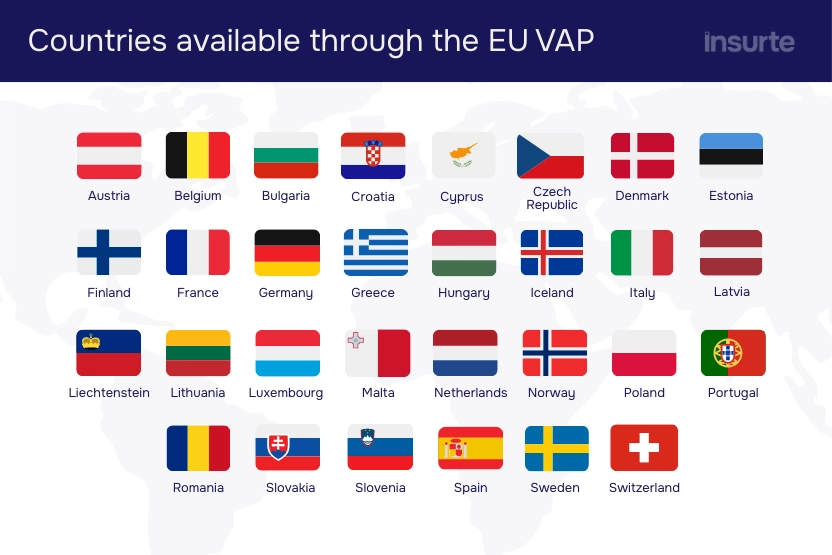
Which countries will you be able to apply to?
The EU VAP is for Schengen visas which means you can apply for a visa from any of the 29 Schengen countries, as well as Cyprus, once the system is up and running.
Schengen countries
Austria, Belgium, Bulgaria, Croatia, the Czech Republic, Denmark, Estonia, Finland, France, Germany, Greece, Hungary, Iceland, Italy, Latvia, Liechtenstein, Lithuania, Luxembourg, Malta, the Netherlands, Norway, Poland, Portugal, Romania, Slovakia, Slovenia, Spain, Sweden, and Switzerland.
How to use the EU VAP
While the process is expected to be easy to navigate in a clean platform, the platform's designs have yet to be announced publicly. Because of that, we don't yet know the definite step-by-step structure.
That said, the visa application process should follow a similar timeline as it does today.
1. Familiarize yourself with the requirements for your Schengen visa
Schengen visas have strict, specific requirements. These include things like proof of accommodations and finances, compliant Schengen visa insurance, a valid passport, and more.
When you start the process through the EU VAP website, you will be told exactly which documents you'll need to provide alongside your visa application form.
2. Prepare your documents
Once you know which documents you’ll need, it'll be time to get everything together. Pay close attention to specific requirements. In some cases, you may need to get some of your documents officially translated. In others, a notary or even an apostille could be required. It really depends, so make sure you double-check everything.
Because EU VAP is online, you will need to upload your documents digitally. Make sure every document is clear, with natural lighting, and completely legible. Most importantly, follow the directions given to you through the official EU VAP site.
3. Secure your flight itinerary and Schengen accommodations
As part of your required documentation, you’ll need to show a flight itinerary and proof of lodging. Accommodations can be a hotel or a resident hosting you.
4. Get your Schengen insurance certificate
Another document you’ll need to provide is Schengen visa insurance, which is a mandatory requirement for all Schengen visa applicants.
5. Submit your documents and pay the visa fee
After uploading and submitting all of your documentation, you’ll need to pay the visa application fee, which you'll be able to do directly through the platform. Make sure your credit or debit card is ready.
There isn’t a standardized fee on EU VAP. Visa application fees depend on a variety of factors, such as the age(s) of the applicant(s), the country you’re applying to, and the type of visa.
6. Follow the application steps and prompts on EU VAP’s online Schengen visa platform
Once you have everything ready, you can complete the online application by following the prompts that the site provides to you. The platform is designed to guide you step-by-step.
7. Schedule your biometric appointment
If it's your first time applying for a Schengen visa, or you haven't submitted fingerprints in the last 5 years, you will need to schedule a biometric appointment at an approved visa application center or consulate in your country of residence.
This is the only in-person step required in the process. If you've submitted biometrics recently (within the last 59 months), you may not have to attend a biometric appointment. You will be prompted to make an appointment if needed.
Tips to prepare for your Schengen visa application on EU VAP
A few things you can do to improve your EU VAP experience are:
Double-check all of your documents before uploading them to EU VAP
- Ensure that your files are formatted in the way that EU VAP has asked.
- Make sure the information you have typed in is correct and that all of your dates line up with one another. For example, your travel insurance should be valid for the entire duration of your trip, and your accommodation dates should start when you arrive and end when you leave.
- Check that the files have uploaded correctly and are clear and legible.
- Have your credit/debit card ready to submit your visa fee payment.
- Save, screenshot, or write down any confirmation numbers/information you’re given after you’ve submitted your finished application, just in case.
- Don’t delete any of your files or documents after you’ve submitted your application.
- Save your biometric appointment confirmation.
Will I receive my visa from EU VAP in the mail?
No. This is another big change in the Schengen visa process. Through EU VAP, visas will no longer be printed into your passport. They will be digitally linked to your passport.
This means there is no physical visa.
When does EU VAP begin?
EU VAP is set to begin rolling out in the coming months/years.
Countries will be allowed a transition period to learn and adopt the new system. Some countries will adopt EU VAP before others, but all countries are expected to adopt this new visa-processing after 2030.
EU VAP FAQs
Sources
The European Commission: https://home-affairs.ec.europa.eu/news/everything-you-need-know-schengen-visa-digitalisation-2023-12-01_en
The European Union, Migration and Home Affairs on Schengen Visa Applications: https://home-affairs.ec.europa.eu/policies/schengen/visa-policy/applying-schengen-visa_en