
Christmas in Rome (2026): Markets, Events & Closures Guide
Sarah Pardi - October 12, 2026
Home > Travel Guide > Travel Planning > Christmas in Rome (2026): Markets, Events & Closures Guide
Share this post
Planning to spend Christmas in Rome is a bucket-list item for many, and the experience isn’t like anywhere else in Western Europe. While you aren’t going to find the winter market setup you’d find somewhere like Germany or France, Italy offers something unique. There are centuries-old religious traditions (Vatican City is right there), temperate winter weather, and little nooks and crannies filled with twinkling holiday lights.
Because it’s the heart of Catholicism, the holiday season is very special in Rome. Whether you’re planning to check out seasonal markets, want to attend Papal Mass, or are more interested in all of the holiday foods (panettone, for one), this guide has everything you need to know to make your holiday a well-planned and organized one.
Is Rome a good place to go for Christmas?
Yes, but there are a few things you need to know and also prepare in advance to make sure you’re able to do the activities you want to do. The Italian holiday season officially starts on December 8th (which is the Feast of the Immaculate Conception in Catholicism), and then it goes through January 6th (The Epiphany; in Italian it’s La Befana).
In December, Rome is less crowded than it is during the peak tourist season (July and August), but it’s still busy. Christmastime is really popular in the city, so it’s considered high-demand. Both religious pilgrims and holiday travelers head to the city to see the religious events, light displays, etc. This means that planning in advance is crucial if you want to make sure you have a table at a restaurant in the city center, want train tickets, or want to see any monuments or museums, and especially if you need a Schengen visa.
Heading to Rome for Christmas?
Protect your trip with insurance for Italy, 100% online.
What’s closed and what’s open: Dec 24th, 25th, 26th (plus transit schedules)
Rome becomes very quiet on Christmas and its “book-end days” (Christmas Eve and the day after). This is true for most European cities, even other major destinations like Paris. Knowing this ahead of time will help you make a plan, so you’re not wandering Rome like it's a ghost town.
December transit schedule
| Date | Public Transit | Major Attractions and Shopping |
|---|---|---|
| Dec 24th (Christmas Eve) | Runs; free bus lines stop at 9:00 pm | Many places close early. Some all-day closures to be expected |
| Dec 25th (Christmas Day) | Metro runs; Linea 100 runs; schedules may be modified | Closed (Colosseum, Vatican museums, most restaurants & shops) |
| Dec 26th (Stefano) | Runs; may have adjusted schedules | Museums typically closed; some restaurants and shops open |
Dec 24: What to expect on Christmas Eve (La Vigilia)
Attractions and shopping: Most retail stores and “mom and pop shops” will close early; some may not be open. Some major attractions are closed or on modified schedules (such as half days).
Restaurants and bars: Traditionally, Romans eat seafood on Christmas Eve (this is known as La Vigilia, or the Feast of the Seven Fishes). While some restaurants close, the ones that stay open often require reservations. They also tend to have special, set menus because of the holiday. You’ll need to book well in advance. Other local bars and eateries are often closed.
Transportation: Public buses and the metro will run on Christmas Eve, but may close early. Trams will be running through the holiday season, but schedules may be altered.
Dec 25: What to expect on Christmas Day (Natale)
Attractions and shopping: Expect all major historical sites (like the Colosseum, Roman Forum, Vatican Museums, etc.) to be closed. Stores, banks, and most grocery stores will also be closed.
The Vatican: Vatican museums are closed on Christmas Day, but Vatican City is open with modified schedules and more limited access. For instance, St. Peter’s Basilica is open with a modified schedule, and there will be ticketed events. These tickets are notoriously difficult to come by, and you must apply for them well in advance. While they’re free, application doesn’t guarantee admission.
Restaurants and bars: Plan for restaurants and bars to be closed. While an odd couple might be open, it isn’t worth counting on.
Transportation: Some services are closed, and others operate on a modified schedule. Taxis may be available, but it depends on each company, as many drivers will be off. If you need transport, book a taxi in advance.
What to do when everything is closed: The streets will be emptier than normal, which is a great opportunity for photo ops! You can stroll through public streets and squares (Piazza Navona, for example), and explore churches that are open after Mass. Some tour companies or private guides may have availability this day, so that’s worth looking into too. If you’re renting accommodations with a kitchen, plan ahead and have food and coffee ready to cook and prepare at home. If you’re in a hotel, reach out to them and ask about your options on Christmas Day.
Dec 26: What to expect on Boxing Day (Santo Stefano)
Attractions and shopping: Unlike in the States, the 26th of December is an official holiday in Italy. This means that state museums and many historical sites will still be closed. Some privately owned museums and attractions, as well as tour companies, will start to reopen.
Restaurants and bars: Some restaurants, cafes, and bars will reopen, but still may be on a modified schedule. Some will remain closed.
Transportation: Public transportation will run, but may be on a holiday schedule.
Vatican City’s Christmas events
It’s the epicenter of the Catholic Faith – and it’s even its own Country (if you didn’t know). There are Christmas events, but they’re incredibly popular and limited.
| Event | Time | Location | Ticketing |
|---|---|---|---|
| Midnight Mass (Dec 24th, Christmas Eve) | 10:00 pm | St. Peter's Basilica | Tickets required. Free, but must apply 2-3 months in advance. Application doesn’t guarantee admission |
| Christmas Mass (Dec 25th, Christmas Day) | 10:00 am | St. Peter's Basilica | Tickets required. Free, but must apply 2-3 months in advance. Application doesn’t guarantee admission |
| Urbi et Orbi Blessing (Dec 25th, Christmas Day) | 12:00 pm (noon) | St. Peter's Square | Free, no tickets required. Open to the public |
| 100 Presepi Display (100 nativities) | 10:00 am to 7:00 pm | St. Peter's Colonnade | Free, no tickets required. Open to the public |
How to attend Papal Christmas Mass
The Pope celebrates Holy Mass on Christmas Eve and Christmas Day in St. Peter’s Basilica. Christmas Eve Mass is at 10:00 pm and Christmas Day Mass is at 10:00 am the following morning.
How much it costs: Papal events are 100% free to attend. If you see tickets that come at a fee, you’re likely on a third-party ticket broker site or a tour operator site. While tickets are free, they’re limited and require an application.
How to request: You can request tickets on the official website: https://eventi.pontificalisdomus.va/. You’ll be required to create an account with an email address and password.
When to apply: For the best chance, you should apply several months before the holidays (many people begin applying in the Spring or summer the year before, for instance). Tickets for Midnight Mass and Christmas Day are in high demand.
If you don’t get a ticket: If you aren’t able to get a ticket, you can still go to St. Peter’s Square (for free). The Mass will be broadcast there. Keep in mind that it’s outdoors and a public event, so there are typically large crowds.
The Urbi et Orbi Blessing (on Christmas Day)
At noon on Christmas Day (December 25th), you can see the Pope from the central balcony of St. Peter’s Basilica, where he will deliver his traditional Urbi et Orbi message and apostolic blessing (Urbi et Orbi means “To the City and to the World”). Tickets aren’t required, and it’s a free, public event, but because of this, it can be exceptionally crowded. Most visitors arrive hours before the event to line up and then get a good spot.
Rome Christmas weather and what to pack
Rome isn’t a snowy Christmas destination, even if it’s something portrayed that way in the movies. Snow in Rome is uncommon. Instead, the weather is really similar to Central California or the Oregon coast.
What weather to expect
| 🌦️ | Rome | San Francisco | New York City |
|---|---|---|---|
| Average Daily High | 55℉ (13℃) | 56℉ (13℃) | 47℉ (8℃) |
| Average Nighttime Low | 39℉ (4℃) | 46℉ (8℃) | 35℉ (2℃) |
| Rainy Days | ~8-10 days | ~10 days | ~9-10 days |
| Daylight Hours | ~ 9 hours | ~9 1/2 hours | ~9 hours |
| Sunset | Around 4:40 | Around 5:00 | Around 4:30 |
Rome has a moderate climate, so it isn’t that cold, but it also isn’t warm in December. You can compare it to San Francisco or New York City in the table above. The daytime high is similar to San Francisco, but the nighttime low is between that and New York City’s. There’s about the same amount of rainfall as San Francisco and NYC, and similar daylight hours.
This means that you’ll want to bring:
- Warm shoes that keep your feet dry. Cobblestones can be slippery, and rain is common, so bringing waterproof shoes that are comfortable to walk in is important, especially if you plan to wait in any long lines for Vatican City.
- Layers. The days aren’t usually that chilly, but temperatures drop once the sun sets, and the sun sets early. Think a warm coat, scarves, a beanie, and a small umbrella.
- While it usually isn’t an issue in the winter, since people are bundled up, there are dress codes in some places in Italy. Make sure your knees and shoulders are covered.
Our European Travel Essentials guide also has a few things you may not have thought of, like which travel adapter for Italy you'll need.
Rome’s Christmas markets & where to see the lights
Rome’s Christmas markets aren’t as famous as the ones you see in Germany or Eastern France, but they’re still a special experience where you can find local delicacies, handcrafted items, and beautiful decorations.
Top Christmas markets in Rome
| Christmas Market | Where to Find It | When It's Open | What to See |
|---|---|---|---|
| Festa della Befana | Piazza Navona | Dec 1 - Jan 6 | Handmade crafts, food, a stage with events |
| Il Villaggio di Natale di Piazza Mazzini | Piazza Mazzini | Dec 1 - Jan 6 | Christmas houses with lights, locally made handicrafts, Christmas decorations |
| Borgo di Babbo Natale | Borgo Terraluna | Nov 15 - Jan 6 | Requires tickets, massive “Santa Claus Village” with activities |
Where to see the Christmas lights in Rome
Rome has Christmas lights throughout the city, and some places are famous for their annual displays. If you head out after 5:00 pm, you can walk to the following locations and see the lights. Don’t forget that it gets chilly after sunset, so dress accordingly.
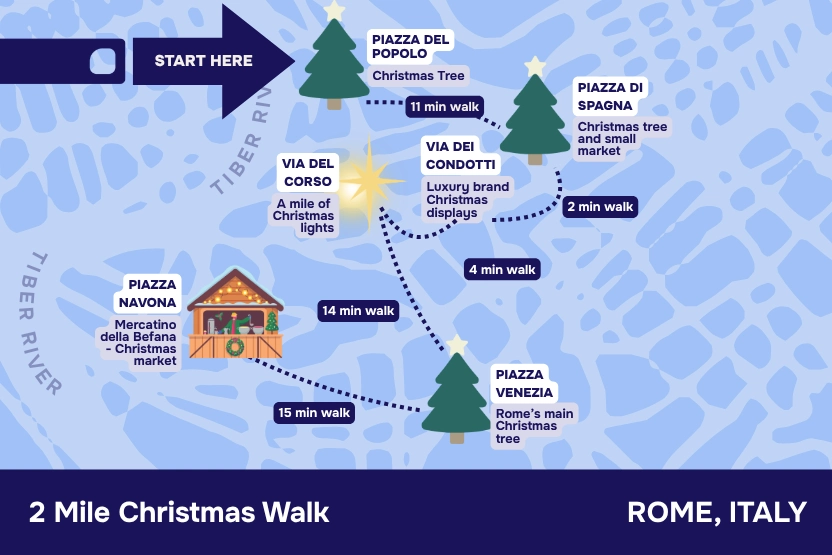
Depending on where you're staying in Rome, you may be able to do a walking loop.
Via del Corso
Via del Corso is probably the most famous street at Christmas time. It’s the city’s main shopping avenue, and during the holiday season, there are nearly 2 kilometers (just over a mile) of lights to see. They run from Piazza del Popolo down to Piazza Venezia.
Via Condotti and the Spanish Steps
Usually, Rome’s luxury fashion district has Christmas displays. Rome’s official tourism board even called it “a luxurious and glittering shopping catwalk.” Fashion houses like Maison Bvlgari are known for putting up one-of-a-kind Christmas displays. The Spanish Steps (nearby) also have a Christmas tree.
Trastevere
Trastevere is a neighborhood in the city, across the Tiber River. Usually, you can find festive Christmas lights there in the medieval alleys.
Rome’s Christmas tree at Piazza del Popolo
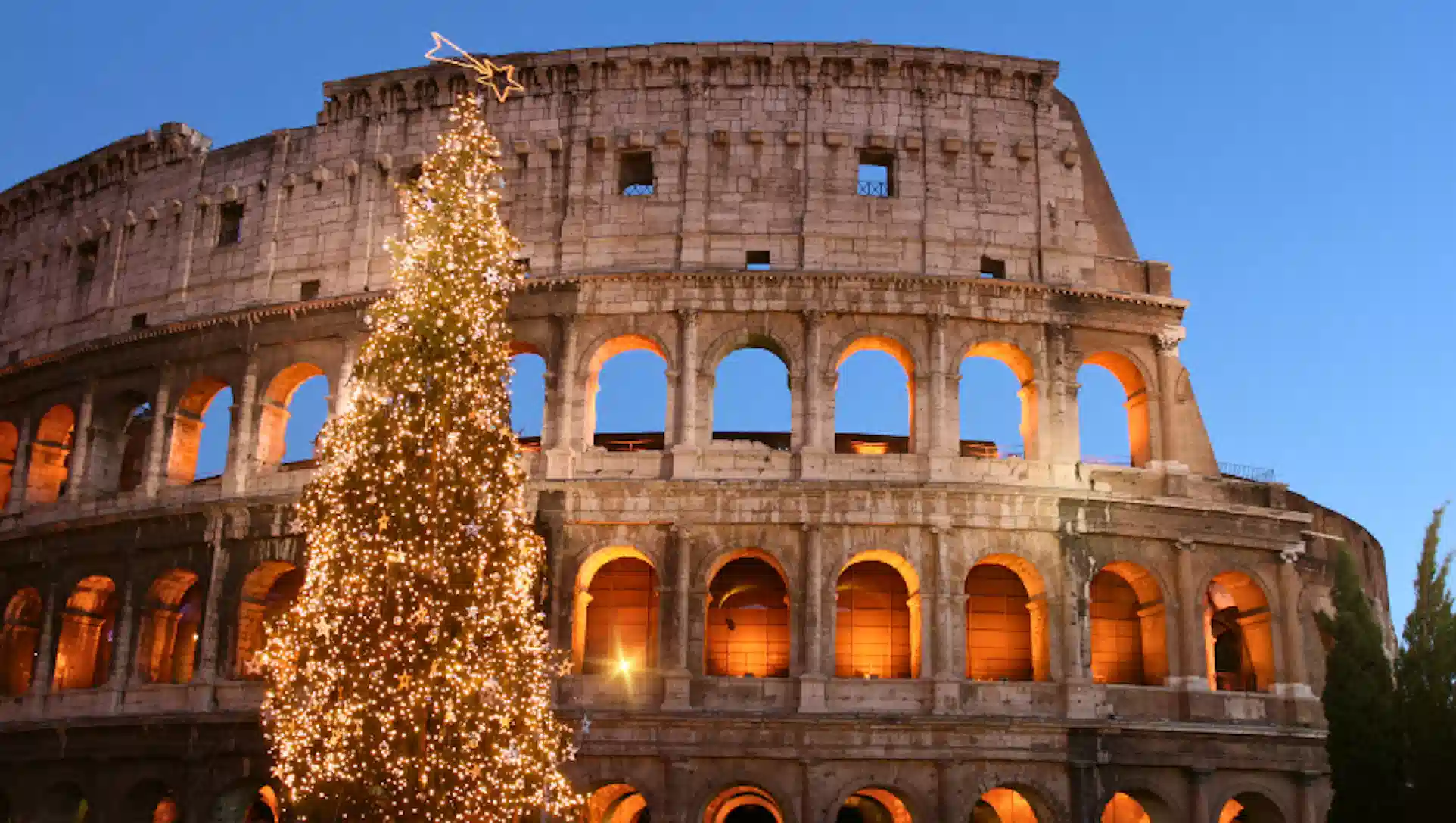
Rome always has an impressive Christmas tree – usually 65 feet (20 meters) tall, lit with thousands of bulbs and Christmas ornaments, and with a big star on the top.
Safety tip: Crowd safety and belongings
Areas with lights can get busy around the holiday season, with locals and tourists like. Places like Piazza Navona (where the Christmas market is) and Roma Termini can attract highly skilled pickpockets. Keep your valuables in front-facing bags, and make sure you get a travel insurance policy that covers things like lost bags and passports.
Where to see nativity scenes (Presepi) & the Zampognari
Nativity scenes are common around Rome during the holiday season. They’re an Italian tradition with deep roots, dating all the way back to St. Francis of Assisi in the 13th century.
Where to find the best Presepi
- 100 Presepi at the Vatican: This is probably the most famous exhibition. There are literally 100 nativity scenes that fill Bernini’s Colonnade in St. Peter’s Square. Artists, people, and groups apply to show their nativity scene here, which means you will see all kinds of interpretations and styles, from wood and terra cotta to even mechanical ones.
- Living Nativities (Presepe Vivente): Certain basilicas, churches, and neighborhood communities host live re-enactments with actors, period clothing, and even live animals.
The Zampognari (Bagpipers)
When you’re wandering around the historic center in December, you’ll likely come across the Zampognari. It’s a tradition where sheep farmers and musicians wear sheepskin vests, wool leggings, and travel from the nearby mountains to play Christmas carols and traditional music on the zampogna (sheepskin bagpipes).
Authentic Italian Christmas foods to try
Italy is famous for its food. After all, there always seems to be an Italian restaurant in any given major city around the globe. When you’re at a restaurant or Christmas market, and it’s your first time in Italy, you’ll definitely want to try the local food, especially traditional ones.
| Food/Drink | What It Is | What's In It | Where to Find It |
|---|---|---|---|
| Pannetonne | Sweet bread, "cake" | Dome-shaped, airy cake with candied citrus, raisins, and butter | Traditional bakeries (Pasticcerie), grocery stores, Christmas markets |
| Pandoro | Sweet bread | Star-shaped, yeasted bread from Verona. Served warm with powdered sugar | Specialty food shops (Gastronomie), Christmas markets |
| Cioccolata Calda | Beverage | Incredibly thick, dark chocolate served hot. More similar to a warm chocolate pudding than hot cocoa | Historic cafés (e.g., Sant'Eustachio il Caffè), some Christmas markets |
| Torrone | Candy | Very dense nougat made with honey, egg whites, sugar, and toasted almonds or pistachios. Can be soft or hard | Christmas markets, some seasonal pop-up shops |
| Castagne | Sweet snack | Sweet chestnuts roasted over open coal braziers, served piping hot in paper cones | Street vendors in the city center and at Christmas markets |
| Vin Brulé | Adult beverage | Mulled red wine infused with orange peel, cloves, star anise, and cinnamon sticks | Christmas markets, street vendors, restaurants |
| Baccalà Fritto | Meal | Salted cod battered and deep-fried | Traditional Roman trattorias, some restaurants |
Health & emergency preparedness
Medical emergencies can be scary no matter where you are, but if one happens when you’re overseas, that can add an additional layer of stress. This is why understanding a bit about what to expect beforehand can provide you with a lot of peace of mind if one occurs. That, and making sure you have the right travel insurance policy to be there for you and guide you. Some medical clinics and most neighborhood pharmacies (farmacie) will have reduced availability because of the holiday season. Some may even close completely from December 24th through the 26th.
| Service | What You Might Expect | How to Prepare |
|---|---|---|
| Neighborhood pharmacy | Partial or complete closures and/or holiday hours | Bring any required medication with you. Have a few items on hand, like pain meds and Band-Aids |
| Public hospitals | Emergency rooms are open 24/7 | Have a travel insurance policy to help you find the best care in your area |
| Helplines | Italy's emergency number is 112 | Your travel insurance policy will also have a 24/7 helpline (for all medical emergencies, call 112) |
The must-sees for a Christmas trip to Rome
If you have 72 hours in Rome, or just want a few ideas of what to do, these are the holiday musts. Keep holiday hours and closures in mind when planning which day to do what. For even more ideas, you can see our 3-Day Rome Itinerary.
- See the Colosseum and Forum
- Grab a coffee near the Pantheon
- Walk around Via del Corso, Piazza di Spagna, and see the Christmas lights
- Trevi Fountain
- Explore Vatican City and visit St. Peter’s Square
- See the 100 Presepi exhibit at Bernini’s Colonnade
- Try a hot chocolate in Prati
- Explore the Christmas markets – Piazza Navona, etc.
- Try a warm torrone or fresh-baked panettone
Frequently Asked Questions
You might also be interested in...
Staying in Rome? Know what you're going to need to pay in tourist tax ahead of time.
What else is there to do? Check out our list of non-touristy things to do in Rome
 Sources & references
- Internal Expertise & Review
- For more than 15 years, we've been helping travelers feel more confident when they travel to Europe. Our team of Schengen visa experts and European travel advisors is committed to producing guides and resources to help travelers have the best experience possible on their trips to Italy!
- Christmas Activities in Rome:
- Trees & Nativities : Information on Christmas trees, nativity scenes, and lights around the city from Rome's official Tourism Board
- Christmas Lights in Rome : Where to see Christmas lights in Rome
- Public Transportation:
- Holiday Hours & Info : Holiday hours and information from Rome's official tourist board
- Christmas in Vatican City:
- Holy See Calendar : The Holy See official calendar
- Christmas Mass Info : Information on Christmas Mass in Vatican City, official site
- Written by:
- Sarah Pardi - Staff Travel Advisor
- Fact-check and reviewed by:
- Clément Goubon
- Last updated:
- October 12, 2026
Learn more about our editorial standards and review process in our Editorial Policy.
Related posts



Upcoming travels ? Get Insured !
Find the right insurance for your trip by using our powerful comparison tool!
Sarah Pardi - October 23, 2026