
Home > Travel Guide > Travel Safety & Health > Can you drink tap water in Paris?
Share this post
In 2025, France welcomed over 120 million foreigners, many of them heading to the beloved city of Paris. There’s something that many of them do on day one: buy a bottle of water that they actually don’t need.
The quick answer: yes! Paris’s tap water is safe, thoroughly monitored, and free! The longer answer, however, is more interesting because the water that comes out of the tap in the 3rd arrondissement, for example, isn’t the same as the water in the 18th – and most people don’t talk about it.
Before You Go to Paris...
Protect your trip with top-rated insurance, 100% online.
Is tap water in Paris safe to drink?
Yes, the tap water in Paris is safe to drink. It meets both French and EU drinking water standards, which are stringent. The water that flows through Parisian pipes is monitored and analyzed daily by Eau de Paris, the municipal utility. They run more than 300,000 tests every year. In fact, a team of 75 people is dedicated to just this, in a designated laboratory just outside the city.
Where does Paris tap water come from?
About half of the tap water from Paris comes from surface water and the other half from underground springs. There are around 102 spring catchment areas that feed about 261 miles of aqueducts. Most of these aqueducts use gravity to keep the water moving. Then, the water winds up at one of five main reservoirs before it is eventually pumped into pipes in Paris. Where exactly the water ends up depends on the part of the city.
Paris is divided into four supply zones, which means depending on where you are in the city, the fountains may have water from somewhere else. Regardless, it’s all still monitored and tested, and perfectly safe to drink.
| Zone | Water Source | Treated at |
|---|---|---|
| East Paris (Parts of the 10, 11, 12, 18, 19, and 20) | The Marne and Seine Rivers | Joinville and Orly |
| City Center (Parts of the 1, 2, 3, 4, 5, 6, 7, 8, 9, 10, 11, 12, 12, 14, and 15) | Loing and Voulzie Springs | Longueville and Sorques, then Montsouris Reservoir |
| Southwest (Parts of the 13, 14, 15, and 16) | Vanne Springs and Seine River | L'Haÿ-les-Roses and Orly |
| Northwest (17, parts of 16 and 18) | Avre Springs | Dedicated aqueduct |
The Loing Springs alone supply about a quarter of the water that Parisians and visitors consume (drinking, bathing, washing, etc.). If you’ve ever noticed that the water varies a bit across the city, you aren’t imagining it. But, at the end of the day, it’s all safe.
Paris tap water quality, minerals, and hardness
How mineral-rich is Paris tap water?
Paris has moderately mineral-rich water. Below, you’ll find a snapshot of recent water analysis (April 2026). Every test conducted met a compliant result against strict regulatory standards.
| Tested for | Result | Meets Regulatory Standards? |
|---|---|---|
| Water hardness | 30,19 °f (hard) | ✓ |
| PH | 7.63 | ✓ |
| Magnesium | 3,2 mg(Mg)/L | ✓ |
| Calcium | 115,5 mg/L | ✓ |
| Sulfates | 19.40 mg/L | ✓ |
| Nitrites | <0,01 mg/L | ✓ |
| Coliform Bacteria | <1 n/(100mL) | ✓ |
| E. Coli | <1 n/(100mL) | ✓ |
| Color | "0" | ✓ |
| Flavor | "0" | ✓ |
| Odor | "0" | ✓ |
Because Paris’s water usually sits on the upper end of moderately hard and the lower end of hard, it means there is quite a bit of calcium and magnesium in it. There are no adverse health effects, but this is what creates that limescale residue in your kettle, coffee maker, or on your sink faucets. It isn’t harmful, but is a bit annoying to clean.
Tap water or bottled water in Paris, which should you choose?
Of course, you can choose what you prefer, but the table below shows you a comparison between the two.
| Criterion | Tap Water | Bottled Water |
|---|---|---|
| Cost per liter | Virtually free | 0.20 to 1.50 euros in shops, more in cafés, more if refrigerated |
| Testing | Daily testing | Tested at source |
| Carbon footprint | Negligible | Production, transport, disposal |
| Availability | Every tap, around 1300 free fountains | At stores, in vending machines |
What this means for travelers? Tap water is the better choice in Paris. It is free, safe, and available pretty much everywhere. While you may want to opt for bottled water if you want a specific mineral profile, are mixing baby formula for an infant, or want refrigerator-cold water, tap water is a great choice for the average person exploring the city.
Free drinking fountains & where to find them
Paris is filled with free drinking fountains. In fact, the city has one of the densest public drinking fountain networks in all of Europe with nearly 1,300. You can find them on public streets, parks, gardens, and green spaces – and they come in a few different forms. Arguably the most beautiful, the cast-iron Wallace fountains are maybe the most famous. The modern Mât-Source models were installed for the 2024 Games. There are also plain bornes-fontaintes in gardens, and three more unusual fountains that draw water from the Albien Aquifer 600 meters below the city! These are in the 13th, 16th, and 18th arrondissements.
You can find all of the fountains around the city on an official, interactive map at fontaine.eaudeparis.fr. They’re also typically listed on Google Maps.
If you’re visiting in the winter, especially when it’s really cold, some of the fountains may be shut off to prevent freezing and pipe bursting, but they all reopen when the weather starts to warm back up. That said, many of them are kept running year-round so there is still free, public water access for those who want and need it. This is just the public fountains, though. Fountains in buildings and tap water should still be running.
A short history of the Wallace fountains
There are 107 of them (not 1200, as you might see elsewhere. This confusion is a mix-up of the total number of fountains in Paris rather than this one type).
The design dates back to 1872, and they were funded by… Richard Wallace, a British philanthropist who paid for them after the Siege of Paris left the city short of accessible drinking water. Each fountain has four caryatids (female figures). They represent kindness, simplicity, charity, and sobriety. Fifty of them even have a misting system added to them for really hot days (which there are more and more of). If you want to see one of the misting ones, you can at Place Émile Goudeau in Montmartre, just downhill and around the corner from Place de Tertre. Keep in mind it doesn't mist constantly, just occasionally.
Paris also gives away sparkling water
This is a perk that most visitors have no idea about. Paris has 17 free sparkling water fountains. Today, other cities in Paris offer sparkling water too, but Paris was the first in France.
Sparkling water fountains opened in 2010 at the Jardin de Reuilly. Now, you can find others in Parc André Citroën, the Jardin d'Éole, Parc Montsouris, the Buttes-Chaumont, Place Léon Blum and the Halles, and others. The water is chilled, carbonated and completely free (just bring your reusable bottle).
How to get free tap water in Paris restaurants
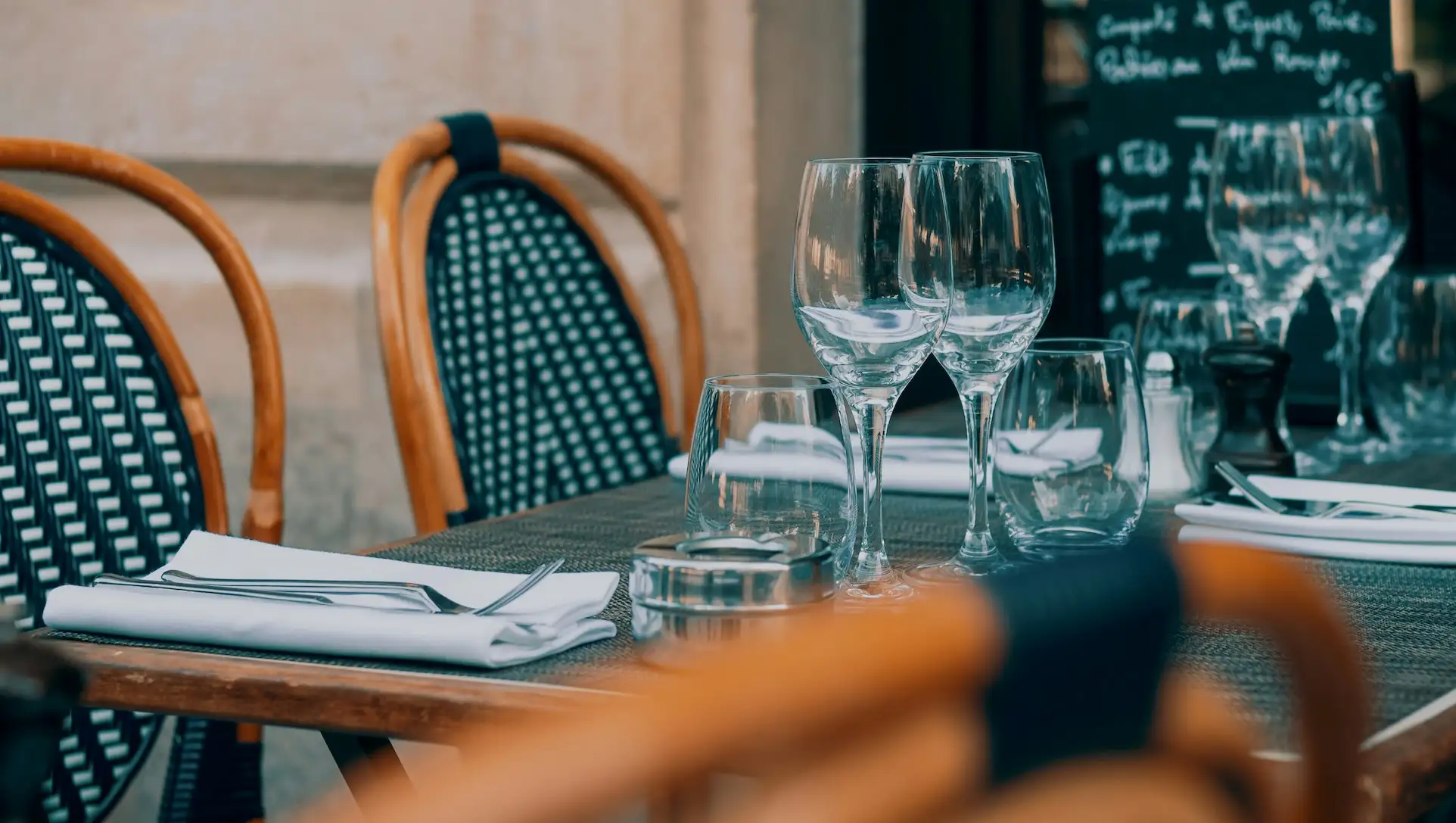
If you’re eating at a restaurant in France, they have to provide ordinary tap water, free of charge. It’s actually a legal right from an order dated June 8th, 1967, which lists bread and tap water as part of the cover charge included in the price of your meal. Since January 2022, establishments also have to state visibly on their menus (or a conspicuous sign) that free drinking water is available (this is part of an anti-waste initiative and law).
While most restaurant servers in Paris speak some English, they may still bring you bottled water if you simply ask for “water”. They may also not know the term “tap water”. Instead, you can ask for une carafe d’eau (oon ka-RAF doh) or a carafe of water even. If the server brings you bottled water, before you open it, the polite answer is de l'eau du robinet, merci, pronounced duh loh doo ro-bee-NEH. This means “water from the faucet, thank you.”
Protect Your Parisian Vacation
Make sure you have the travel insurance you need.
Asking for tap water is completely normal, and nobody will think less of you for it, even at fine-dining restaurants. Parisians do it every single day.
Want to learn more about Parisian dining? Check out our French Tipping Guide.
Should you filter Paris tap water?
For short visits, it probably isn’t worth the effort, but you can if you want, of course. If you live in Paris, you may decide to prevent calcium build-up or for a smoother taste.
| Option | Cost | Improves flavor | Best for... |
|---|---|---|---|
| Just the tap | Free | No | Anyone |
| Jug in the fridge | Free | Yes | Everyone |
| Filter pitcher | ~30 euros | Yes | Residents bothered by taste/build-up |
| faucet-mounted filter | ~80+ euros | Yes | Residents bothered by taste/build-up / less fridge space |
One thing that you should know about filter pitchers that isn’t common knowledge – a cartridge that is left in past its replacement interval can harbor bacteria. Make sure that you’re changing the filter as recommended.
Staying hydrated in Paris
It is not uncommon for tourists to walk 6 or more miles a day in Paris without even realizing it. Meandering through the Louvre, the Marais, Montmartre… in the summer, you need regular water, especially if it’s a hot one!
Fill a reusable bottle at your hotel before leaving in the morning, then refill it at fountains throughout the day. Ask for a carafe at lunch and dinner. You can also keep an eye out in business windows. Some display a sign that says “Ici, je choisis l’eau de Paris”. If they display this sign, it means they will refill your bottle for you if you ask.
A 750 ml bottle refilled three or four times a day can help you stay hydrated and save several euros a day per person. It’s really one of the most useful things you can pack.
Frequently asked questions about tap water in Paris
 Sources & references
- Internal Expertise & Review
- For more than 15 years, we've been helping travelers feel more confident throughout their journeys. We're committed to providing quality guides and resources for travelers heading to Paris and across the European Union and Schengen zone.
- Water Quality:
- Directive (EU) 2020/2184 : Legal text on the quality of water intended for human consumption in the EU
- Tap Water Safety : Information on the quality of tap water across the EU, and the European Union's commitment to safe, clean water for all
- Eau de Paris : Information and advice dedicated to drinking water in Paris
- Latest Water Analysis : Latest analysis for Paris tap water
- Water Zone Map : Map of Paris water zones; which areas of the city get water from which sources
- France Tourism
- 2025 France Tourism Info : European Union press release regarding a banner year for tourism in France
- Written by:
- Sarah Pardi - Staff Travel Advisor
- Fact-check and reviewed by:
- Clément Goubon
- Last updated:
- August 5, 2026
Learn more about our editorial standards and review process in our Editorial Policy.
Related posts


Upcoming travels ? Get Insured !
Find the right insurance for your trip by using our powerful comparison tool!