

Getting a VAT Refund in Italy: What to Do in 2026
Sarah Pardi - August 20, 2026
Home > Travel Guide > Travel Requirements, Policy & Authorization > Getting a VAT Refund in Italy: What to Do in 2026
Share this post
Many Italy VAT refund guides are out of date. If they still quote a minimum spend of €154.94, that’s one of the ways you can tell. This minimum was changed in February 2024. The actual threshold in Italy is €70.01. Then, there is another update too. As of July 1st, 2026, the way that your forms get checked and approved at the airport has changed -- for the better.
This guide talks about what applies today, what you can expect to, realistically, get back, and situations that can make it so you don’t get the refund you expected.
What is the Italy VAT refund and how much can you get back?
Italy’s standard VAT is 22%. Non-EU residents who spend €70.01 or more in a single store on the same day can reclaim that tax when they leave the country (so long as it’s within 3 months of purchase). With service fees, travelers don’t get the full 22% back, but they do get some of it. Also, while the bulk of what people purchase do, not all items have a 22% rate.
Different categories have different rates, seen below.
| Typical Goods | VAT Rate |
|---|---|
| Fashion, jewellery, watches, leather, electronics | 22% |
| Some packaged foods, certain pharmacy products | 10% |
| Select food items | 5% |
| Books, newspapers, basic food items | 4% |
The headline rate (22%, 10%, etc., depending on what it is that you buy) and the amount you actually receive often differ due to two different things.
The first is confusion about how VAT is paid for. In Italy, the price tag you see already includes the VAT baked in. This means that if you want to buy a €1,000 handbag, there isn’t a €220 tax on top of that (22%). This also means that because the VAT is baked in, the handbag’s original pre-tax price is actually lower than 1000 euros. So, in this case, the bag would actually be priced at €819.67. The addition of the 22% VAT (which, in this case, is €180.33) makes the bag €1000 total, which is what you see on the price tag. This also means that you won’t get €220 back, even if it might feel that way at face value. A full refund would be €180.33, since the 1000 euro price includes the VAT already.
The second thing is refund operators. Most stores work with something called a refund operator. They are responsible for just that: getting you your refund. Refund operators typically take a commission for the services they provide. It depends on the company, but they often charge anywhere from a fifth to a third of the reclaimable VAT (depending on the amount and how you want to receive your refund).
Both of these factors play a part in how much of your reclaimable VAT you can expect to actually get back.
Who Is Eligible for a VAT Refund in Italy?
| Requirement | Details | Common Mistakes |
|---|---|---|
| Spend at least €70.01 | Purchase must be on the same day at the same store | It is in euros, not dollars or pounds. It is at one store, not added up across several |
| Store must participate in the tax-free initiative | Look for a sign that says "tax-free shopping" or something similar | If there isn't a visible sign, ask store staff. Don't assume participation |
| Cannot be an EU resident | You cannot be a resident anywhere in the European Union | If you live in Ireland, you're not eligible |
| Items are for personal use | Only purchases for personal/family use are eligible | Antiques for resale don't apply |
| Unused items only | Only unused purchases | If you purchase a case of wine and drink a bottle in Italy, you're not eligible |
| 3-month limit | Your goods must leave Italy within 3 months of purchase | Long stays aren't eligible |
| Travel with your goods | You must have your purchase on you when leaving Italy | Buying artwork and shipping it home deems it ineligible |
You can qualify for a VAT refund if all five of the following apply. You are not an EU resident. You bought items in Italy for personal/family use (not for resale). You leave the country with your purchases within three months, and the purchases are with you when you’re traveling (not shipped). You spent at least €70.01 in one store in one day. The store participates in tax-free shopping. They usually have a sign somewhere on the window or in the store itself, but if you’re not sure, you can always ask the staff.
This means that long-stay visitors who have established Italian residence are not eligible to receive the refund. In fact, foreigners who have established residence anywhere in the Zone aren’t. It also means that Britons (who meet the other conditions) are eligible, since the United Kingdom is no longer in the European Union.
Diplomats and staff posted to Italy may have their own exemption routes, so make sure to check beforehand.
Insure your trip
Make sure your trip is covered with reliable travel insurance.
Minimum purchase threshold and what qualifies in Italy
In 2024, the minimum purchase requirement dropped from €154.94 to €70.01 (with VAT included in the price). This is the threshold that applies per store, per day, and it means that you can’t buy a bunch of low-cost items from several different stores and then add up all the receipts to equal more than €70, even if the boutiques are all next door to one another.
To illustrate, three purchases of €60 in three different Milan boutiques don’t qualify, because you have to hit that €70 threshold, and in one place. This also means that a single purchase of more than €71 is eligible.
There are also conditions around what you purchase. Just because you’ve spent the money doesn’t mean you can get the refund.
| Eligible | Not Eligible |
|---|---|
| Clothing, shoes, leather goods | Anything worn or used before customs |
| Jewelry, accessories, eyewear, watches | Items bought for resale or commercial use |
| Cosmetics, body care, and perfumes | Purchases already made VAT-free in store |
| Electronics and small appliances | Cars, motorbikes, boats |
| Art, design objects, ceramics | Goods shipped home |
| Packaged food and wine | Food and wine consumed in Italy |
The fact shipped items aren’t eligible often surprises travelers. This means that asking a boutique to send your purchase by mail eliminates your ability to ask for a tax refund. You have to travel with your eligible purchases.
How is the Italy VAT refund calculated?
As mentioned above, since the VAT is already baked into the ticket price when you shop, you aren’t eligible for 22% of the ticket price (or another rate depending on which category your goods fall in). You can do the math though to see what you’re eligible for.
For the standard rate of 22%, take the price of the item and multiply it by 22. Then, divide it by 122. If you know the refund operator’s fee/commission, you can also subtract that out to see exactly what your refund will be. On a €300 purchase, for example, €66 euros is the VAT. However, after fees, you may get €35 to €45 back instead of the full €66. It depends on the commission the operator charges.
The math: The 22% VAT is in the €300 ticket price. €300 x 22 / 122 equals €54.10. Say the operator has a 30% commission. 30% of €54.10 is €16.23. Subtract that from your original VAT amount: €54.10 - €16.23, and you’re left with €37.87. This is just an example, but doing the math can give you an idea about the refund you can expect to receive.
The other thing you need to think about is the payment method that you used. For instance, cash at the airport might have a different service charge than a refund to the card you paid with.
Now, it can be possible to avoid third party refund operators – but not always. Sometimes, retailers handle the tax-free procedure. If this is the case, there isn’t a commission, so the full VAT is likely to be given back to you. However, when retailers offer this service, it’s only after customs has cleared you, and it involves mailing forms, so it can take weeks. Plus, not every store offers this.
How to get a VAT refund in Italy: Step-by-step process
Nowadays, the process is digital. In September 2018, Italy digitized it through a platform called OTELLO. This means that tax-free invoices are issued electronically, making the turnaround time quicker than it used to be.
Step 1: Shop at a tax-free participating store in Italy
Not every single store in Italy is able to issue tax-free invoices. The retailer has to be registered with OTELLO and, in most cases, under contract with a refund operator. Look for a “Tax-free shopping” sticker on the door, or a sign in the shop. You can also always ask before you pay. The before part is key – once the payment has been made and the receipt has been printed, the transaction is over.
Step 2: Request and complete the tax-free form at the store
At the store, you will need to request and fill out a special form. You’ll also need your passport so your name, passport number, and non-EU address can be collected. Make sure you double-check the details and the spelling of your name is correct. Keep all papers given to you, including the receipt.
Step 3: Get your forms stamped by Customs at the airport
Your forms are stamped when you exit the European Union. If you’re flying directly from Italy back to the US, for example, you’d get them stamped by Italian Customs. If you have a connection in Paris, you’d get your form validated there. It's wherever you leave the EU.
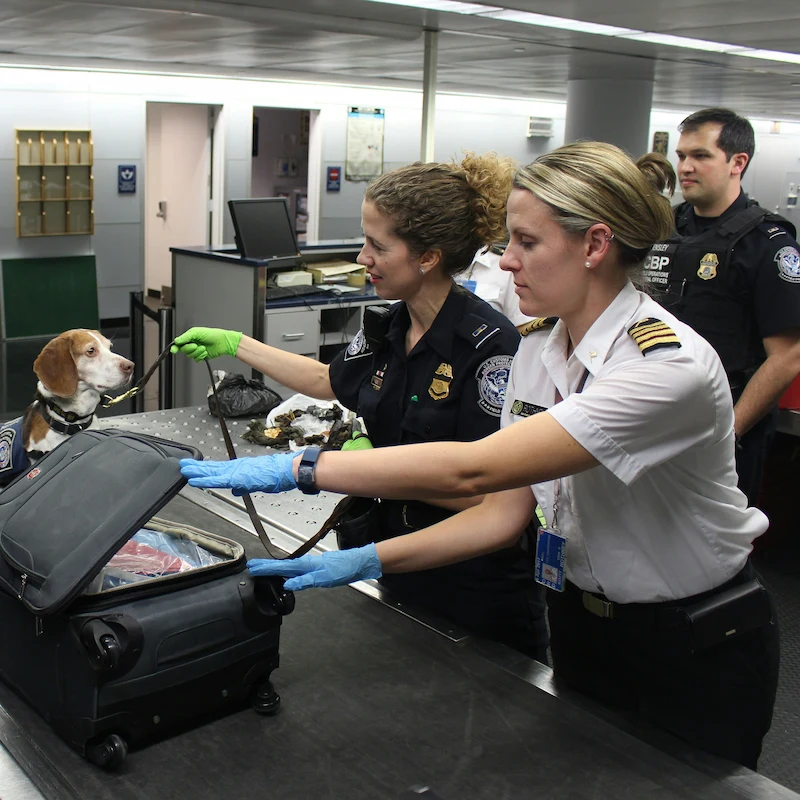
At the exit point (Customs), you will need to present your passport at the refund-operator kiosk or desk in the airport. You can ask staff where to go and/or follow the signs. In some cases, there may not be a dedicated kiosk/desk, so you may need to go to the customs office instead. There, they will direct you through the process. Oftentimes, this includes them physically looking at the goods that you’ve purchased. If that’s the case, they will let you know. Then, once approved, they will stamp your form(s).
Step 4: Claim your refund at the tax refund company office
Once your form has been approved and stamped, you’re able to collect the refund. This usually can happen at the airport. At the operator desk, most of the time, you can choose between cash or card. In some cases, card may be the only option.
You don’t have to do this step at the airport though, which is good to know if the desk is closed, the line is really long, or you’re short on time. Stamped forms can be sent by mail to the operator later, in a prepaid envelope. The 2026 Budget Law says that you have six months to do so. If you miss the six month mark, you won’t be able to receive your refund – even if you got the approval stamp from Customs.
| Step | Action | Where | When | What to Bring |
|---|---|---|---|---|
| 1 | Confirm the store offers tax-free purchases | In store | Before paying | Passport |
| 2 | Request the tax-free form | In store | Before paying, during transaction | Passport |
| 3 | Double-check passport info | In store, at check-out | Immediately | Form/invoice |
| 4 | Keep goods unused and packed | While in Italy | Until departure | Original item packaging |
| 5 | Validate with customs or operator | Final EU exit point | Before check-in if checking bags | Passport, form(s), invoice(s), receipt(s), goods |
| 6 | Choose payout method | At operator desk or kiosk | After Customs stamps your form | Passport, stamped form(s) |
| 7 | Mail forms if desk is closed | Later, after traveling | Within six months | Stamped form(s), prepaid envelope |
VAT refund at Italian airports: What to do before you leave
When you’re at the airport, you’ll need to do a few things. First, make sure that you arrive early. Lines can be unpredictable, and getting the customs stamp you need may be quick and easy, but it might also take awhile. It just depends on the day, the staffing, and seasonality. Go to Customs before you check-in if you’ve packed your item(s) in your checked bag. This is because Customs Officers may need to see the physical goods. Next, get the stamp and then collect your refund at the operator desk/kiosk, or later by mail.
It’s checked bags you need to pay close attention to, since Customs Officers generally need to see the purchased items. Tell the airline that you have tax-free purchases and they will let you know what to do. Tell them before your checked bag is put onto the conveyor belt. Once the bag is gone, it’s generally too late, and you likely won’t be able to get your tax refund approved by Customs – which is mandatory.
For refund operator kiosks, hours may change seasonally, or with terminal constructions or renovations. Check the operator’s website before you fly to see what they say about where you’re flying out of.
There is one other scenario that is worth knowing. If you leave the EU by land, for instance, by train from Italy to Switzerland, you need to get your form(s) stamped at that border crossing, not the airport, since Switzerland isn’t in the European Union. It is in the Schengen Zone, however, so you will not go through border control when you leave and arrive. Make sure you ask an attendant at the train station where to go.
Tax refund companies in Italy: Global Blue, Planet and others
Different boutiques and stores work with different refund operators, and some with exclusive contracts. This means that if a store you shop at only works with one, Global Blue, for example, historically you would need to work with Global Blue for your refund.
However, a huge shift happened July 1, 2026. A reform went into effect that allows operators to validate other operators’ stamped forms. So, that means a Planet desk can now validate a Global Blue form, and vice-versa. Previously, shoppers carrying forms for three different operators would have to get in line three times, one for each different operator, and keep track of which form was for which. Not only does it feel a bit redundant, that also takes time, especially when the airport is busy and the countdown to your gate closure is closing in.
There is a catch, though – different operators charge different fees. The fees aren’t interchangeable. You have to pay the fee associated with your operator, regardless of which kiosk you use.
Common mistakes that cost you your Italy VAT refund
Getting a VAT refund is relatively straightforward, but there are a few mistakes that could cost you. Below, you’ll find six common mistakes that are also avoidable.
| Mistake | Why it Happens | Consequence | How to Avoid It |
|---|---|---|---|
| Asking for the tax-free form after paying | The traveler doesn't know they need it ahead of time | Once paid, it's too late | Ask store staff for a tax-free purchase before paying |
| Wearing or using the goods | The new coat is convenient | Customs won't stamp your form | Keep the tags on, item in original packaging, any seals intact |
| Checking your bag before customs | Habit takes over at check-in | Export can't be visually verified; form not stamped | Meet with customs before checking bag |
| Combining receipts from multiple shops | To add up to the €70.01 minimum | Purchases from multiple stores under €70 aren't eligible | Reach €70.01 in one store, one day |
| Having the goods shipped | It seems easier than carrying everything back home | Shipped goods aren't eligible for VAT refunds | Carry purchases in your bags |
| Typo on the tax forms | Small mistake while rushed at check-out | Forms that don't match your passport may not be validated | Check the invoice before leaving the shop |
Some retailers may staple and seal your shopping bag, but some may not. Either way, you’re not supposed to use your purchases before you leave Italy if you want to be eligible for a refund. If the store has sealed your purchase, an unopened seal is proof at Customs that you haven’t been using your new goods.
Italy VAT refund FAQs: Rates, timelines and special cases
You might be interested in...
Applying for a visa? Did you know Schengen visa applications are going online? In the coming years, a new platform for visa applications will be launched. It is called EU VAP, short for EU Visa Application Platform.
Heading to Rome? See what's around the area and easy to get to in our Day Trips from Rome guide
 Sources & references
- Internal Expertise & Review
- We're a team of European travel experts and Schengen visa insurance professionals. For more than 15 years, we've been helping travelers feel confident when visiting Italy -- from the planning process to entry requirements, insurance, and everything in between. We are committed to sharing Italy travel tips that are accurate, relevant, and up-to-date.
- VAT Refund Information:
- Italian Procedure : The VAT refund procedure from the Italian Authorities
- Written by:
- Sarah Pardi - Staff Travel Advisor
- Fact-check and reviewed by:
- Clément Goubon
- Last updated:
- August 20, 2026
Learn more about our editorial standards and review process in our Editorial Policy.
Related posts


Upcoming travels ? Get Insured !
Find the right insurance for your trip by using our powerful comparison tool!
Sarah Pardi - October 23, 2026