

If you need to get Schengen travel insurance for your visa application, you might have quite a few questions about what exactly is needed.
Whether you're planning a trip for a day, a few days, or something a bit more extended, understanding the insurance you have to have is necessary.
Visa applications for European countries have very specific requirements, and the duration of your travel insurance can directly impact your visa's outcome.
The length of your policy
How long your travel insurance needs to be depends on the type of policy you're purchasing and the specific visa requirements that pertain to your situation.
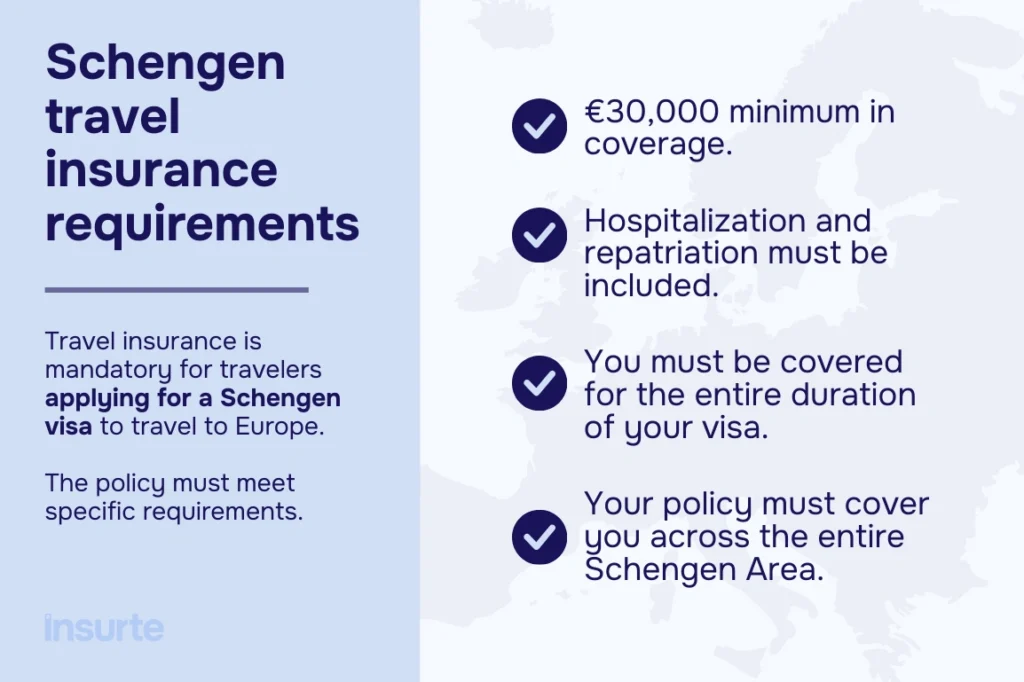
To be Schengen compliant, your travel insurance needs to cover the entire duration of your trip, from the day you enter the Schengen area to the day that you leave.
Most insurance providers offer policies that can cover a single trip for up to 90 days, which is consistent with the maximum duration of Type C Schengen Visas.
Still, most providers do have coverage duration limits, which are usually anywhere from 90 to 120 days, but can be up to 12 months.
Some insurance plans offer longer coverage periods (up to 12 months) for those who are applying for long-stay visas. If you're planning to stay more than 90 days in a Schengen country, the requirements vary, but most of the time, some type of health insurance is required.
You need to choose a policy that can cover you for however many days you're planning to travel.
Applying for a visa?
Get your compliant insurance now.
Make sure you read the terms and conditions of a policy before purchasing, and also check to see if it can be extended in case your travel plans change.
You might also be interested in our guide about different types of travel insurance: The difference between travel insurance vs medical insurance
Travel insurance caps
Travel insurance always comes with a time limit.
Usually, you set that time limit when you purchase your policy. You select which day you want your coverage to start and which day you want your coverage to end.
As said above, if you’re applying for a Schengen visa, the travel insurance policy must cover the entire period of your stay within the Schengen area.
Policy lengths
The length you choose really depends on the length of your trip. If you're heading abroad for 5 days, your travel insurance should cover you for all 5 days.
If you're traveling for 2 weeks, it should cover you for 2 weeks. A month? A month. Etc.
For Schengen visa applications specifically, it's very important that your insurance covers you from start to finish. It's a visa application requirement, so there's not really any way around that.
Extending your coverage
In many cases, you can extend your travel insurance if you decide to extend your trip or if you encounter any delays that require additional coverage. Extending your insurance will depend on your insurance provider and the terms of your policy.
Some insurance providers don’t offer policies beyond 90 days, so if you’ve met the 90-day maximum, it’s best to contact your insurance provider to find a solution.
One thing that's important to know is that you need to extend your coverage before your current policy expires to avoid any gaps.
How to extend your Schengen travel insurance
To extend your travel insurance, you’ll generally need to follow these steps:
- Contact your insurance provider: Get in touch with your provider as soon as you realize you’ll need extended coverage. Be sure to provide your new travel dates and any additional information they may require before your current policy expires.
- Review the policy terms: Some policies may have restrictions on extensions, while others may allow you to add extra days more easily. Be sure you understand any limitations. If you don’t, your insurance provider can assist you.
- Pay the premium: Extending your travel insurance will require additional payment. Make sure to pay any fees promptly to avoid a lapse in coverage.
- Receive confirmation: Once you’ve completed the extension process, your provider will send you a new policy confirmation, which you may need to show to visa or immigration authorities, depending on your plans.
If your insurance expires while abroad
You really want to avoid having your travel insurance expire before your trip ends
First, if you're a visa holder, you could violate Schengen visa requirements, as valid travel insurance is mandatory for the entire duration of your stay.
Without valid travel insurance, you would also be responsible for any emergency medical or travel-related expenses that occur after your coverage expires. This could be costly, especially in the case of medical emergencies.
It’s essential to ensure that your insurance policy is valid for the entire duration of your stay and to extend your coverage if necessary – before it lapses.
 Sources & references
- Internal Expertise & Review
- For more than 15 years, our expert team has been helping travelers get the information and coverage they need. We're more than Schengen visa insurance experts - we're travel lovers. We know how it important it is to have accurate, up-to-date information about entry requirements and migration.
- Schengen Visa Code:
- Regulation (EC) No 810/2009 : The Schengen Visa Code
- Visa Information:
- Schengen Visa Information Sheet : Information on the Schengen area and requirements
- Written by:
- Sarah Pardi - Staff Travel Advisor
- Fact-check and reviewed by:
- Clément Goubon
- Last updated:
- October 1, 2026
Learn more about our editorial standards and review process in our Editorial Policy.